Engineer News Network The ultimate online news and information resource for today’s engineer
Asia is expected to lead the global petrochemical industry capacity growth from new-build and expansion projects by 2030 with 57% share, according to data and analytics company GlobalData.
GlobalData’s report Global Petrochemicals Capacity and Capital Expenditure Outlook, 2021 – 2030 – Asia Leads Global Petrochemical Capacity Additions, reveals that the total petrochemical capacity of new-build and expansion projects in Asia is expected to be 477 million tonnes per annum (mtpa) by 2030. Of this, 465.8mtpa will be from new-build projects and the remaining capacity will be from expansion projects.
Dayanand Kharade, Oil and Gas Analyst at GlobalData, explains: “Asia will continue to dominate the global petrochemicals market with both the biggest number of new projects and the largest absolute capacity expansion, driven by the economic growth of China, India and other Asian countries.”
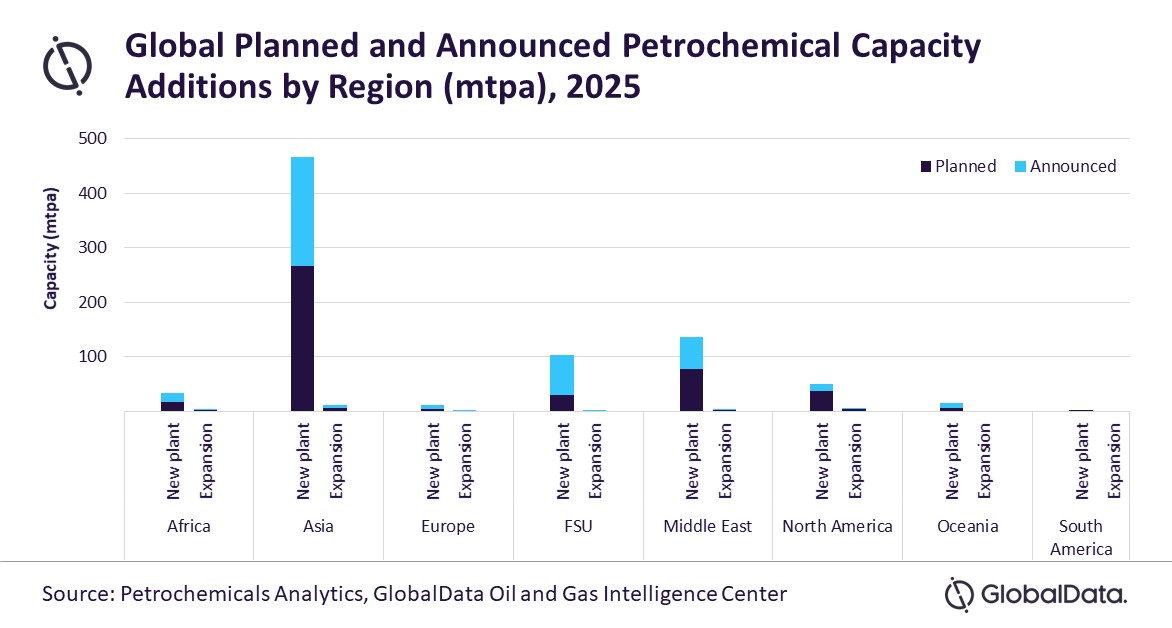
The Middle East is expected to have the second-highest petrochemical capacity additions globally, behind Asia. The region contributes about 140.8mtpa of the total global new-build and expansion petrochemical capacity additions by 2030. Major capacity additions for the Middle East will be from Iran, with a new-build and expansion capacity additions of 83.3mtpa during the period.
Former Soviet Union stands third, with new-build and expansion petrochemical capacity of 104.1mtpa by 2030. Of these, most of the petrochemical capacity additions will come from new-build projects.