Engineer News Network The ultimate online news and information resource for today’s engineer
Pervasive Displays (PDi), a d leader in e-paper displays, announces the introduction of the E24581JS084 9.7-inch tri-color Electronic Paper Display (EPD) modules offering high bi-stable image resolution of 134 dpi and 121 dpi respectively.
Along with their high resolution, ultra-low power operation and fast update cycle, the displays also feature integrated timing controllers, an extended operating temperature range of 0°C to +40°C and one-time programmable (OTP) capability.
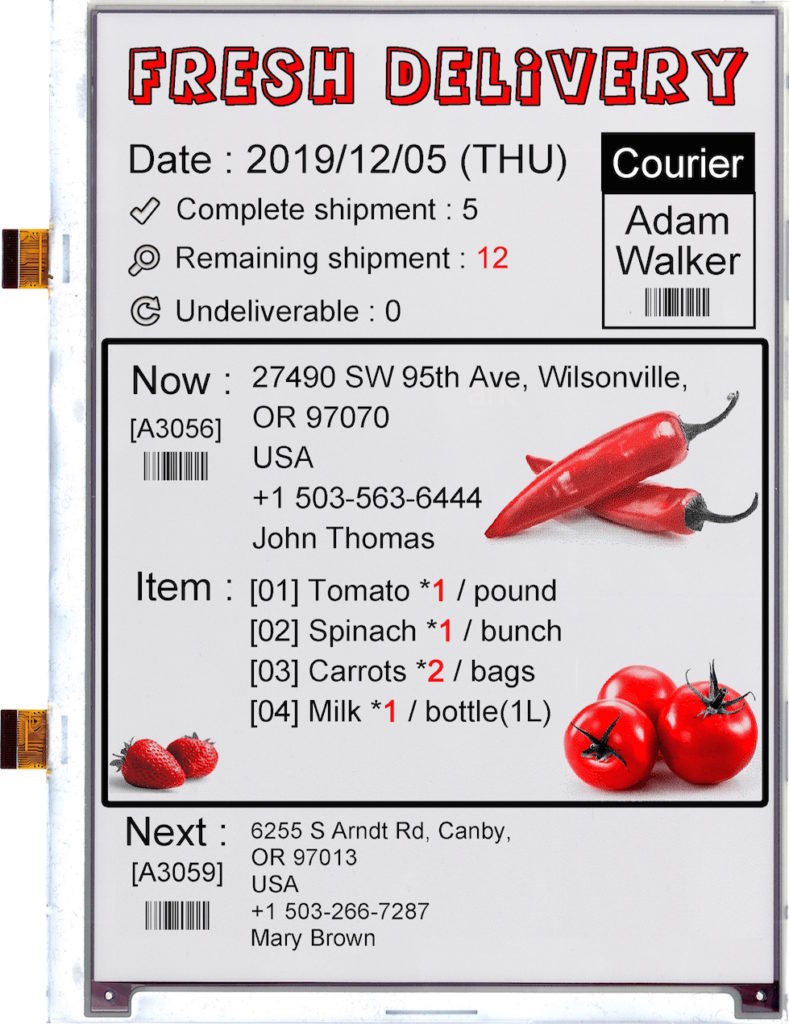
The new additions to Pervasive Displays’ extensive portfolio of EPD modules meet the demands of more challenging environments, such as in healthcare, out-of-home digital signage and information displays, as well as delivering greater functionality for retail applications such as Electronic Shelf Labelling (ESL). By integrating the timing controller, manufacturers are able to realise simpler designs and get to market faster.
The potential reduction in PCB area and bill of materials will also allow a reduction in total size and weight, or more space to be dedicated to the battery, allowing the displays to operate even longer on a single primary cell.
“A key benefit of EPD technology is its persistence when power is removed,” explained Alchin Wang, General Manager, Pervasive Displays. “The new E24581JS084 and E2969JS084 EPD modules build on this by providing greater resolution and a larger display size that can be used in a wide variety of applications where reliability is paramount, such as cold chain food logistics and healthcare.”
The OTP feature of the E24581JS084 and E2969JS084 works alongside the internal timing controller, allowing an image waveform to be stored inside the display driver. This removes the need for the host processor to load an image at start-up, delivering a shorter time to first image and enhancing the overall user experience. Find out more about the displays