Engineer News Network The ultimate online news and information resource for today’s engineer
Kazakhstan is gradually expanding renewable energy as part of its long-term strategy to diversify the national power mix and meet evolving energy transition objectives. The government aims to increase the share of renewable electricity generation to around 15% by 2030 and has outlined broader ambitions to expand low-carbon energy sources as part of its long-term carbon neutrality strategy toward 2060. Against this backdrop, Kazakhstan’s renewable power capacity is projected to increase from approximately 3.5GW in 2025 to around 12.9GW by 2035, according to GlobalData.
GlobalData’s latest report, Kazakhstan Power Market Trends and Analysis by Capacity, Generation, Transmission, Distribution, Regulations, Key Players and Forecast to 2035, shows that wind and solar PV will be the principal drivers of renewable expansion in the country over the forecast period. Onshore wind capacity is projected to rise significantly from around 1.9GW in 2025 to nearly 8.7GW by 2035, while solar PV capacity is forecast to grow from approximately 1.3GW to about 3.7GW during the same period. Together with small hydropower and limited bioenergy capacity, these technologies are expected to drive renewable growth in the country’s electricity system.
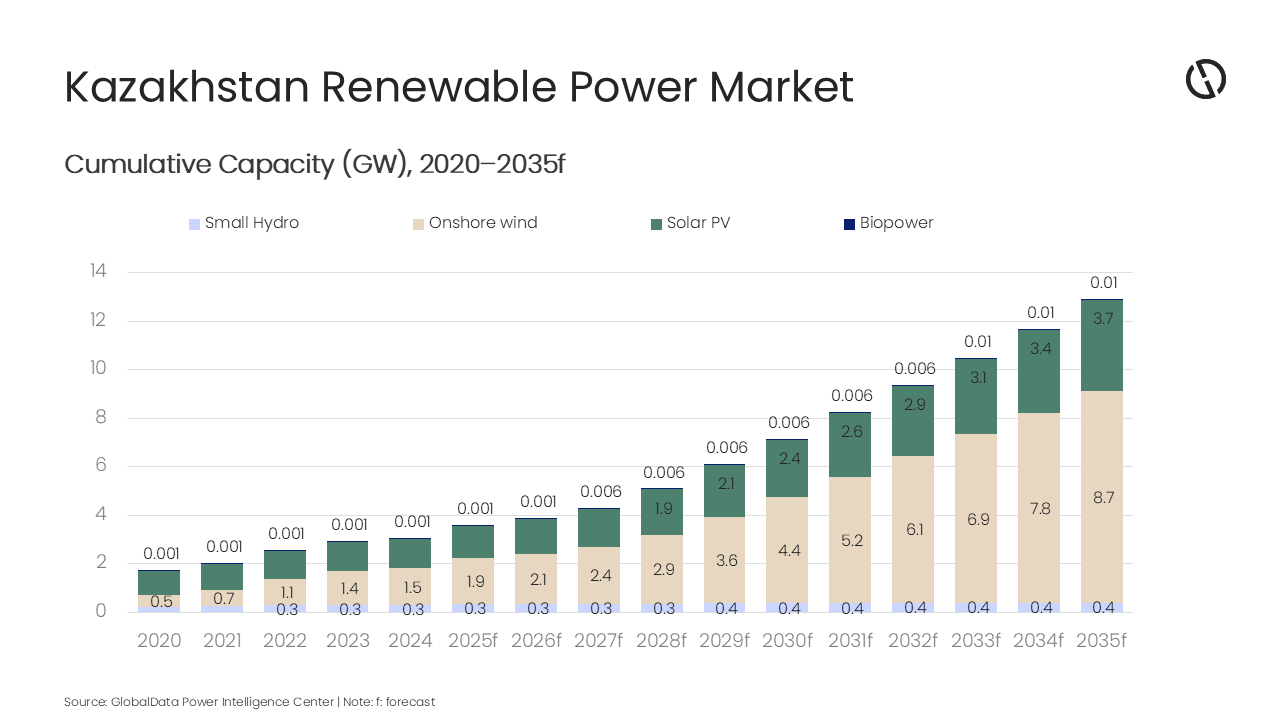
Wind power is anticipated to account for the largest share of renewable additions in Kazakhstan due to its strong wind resource potential and availability of vast open land areas suitable for large scale project development. Competitive renewable energy auctions introduced by the government have accelerated project deployment and attracted international developers. Large scale projects such as the Mirny wind development and other utility scale wind initiatives are expected to strengthen the project pipeline and drive significant capacity additions over the coming decade.
Solar PV capacity is also projected to grow steadily, supported by favorable irradiation levels across the southern regions of Kazakhstan and continued government support mechanisms. Competitive procurement programs and improving project economics have encouraged greater private-sector participation in solar development. Declining technology costs and increasing investor interest are further strengthening the outlook for utility scale solar installations.
Mohammed Ziauddin, Power Analyst at GlobalData, comments: “Kazakhstan’s renewable energy expansion is being supported by a combination of policy reforms, strong natural resource potential, and growing investor participation. The introduction of competitive renewable energy auctions in 2018 created a transparent procurement framework that accelerated the development of utility scale wind and solar projects. At the same time, Kazakhstan’s vast wind corridors and high solar irradiation levels provide favorable conditions for large scale renewable deployment. With a target to increase the share of renewable electricity generation to up to 50% by 2050, the country is steadily strengthening the role of renewables within its long-term power sector development strategy.”
Despite the rapid growth of renewable capacity, Kazakhstan’s power system will continue to rely heavily on thermal generation to maintain system reliability and meet rising electricity demand. Gas-fired capacity is projected to expand significantly from around 6.7GW in 2024 to approximately 12.4GW by 2035, reflecting the government’s efforts to strengthen flexible generation capacity and support system balancing. Coal-fired power plants remain a key component of the country’s electricity system, with installed coal-fired power capacity expected to increase slightly to 14.7GW by 2035.
Ziauddin concludes: “Over the next decade, Kazakhstan’s power sector is expected to evolve through a balanced expansion of various generation technologies. While renewable energy capacity is projected to grow steadily as part of the country’s long term diversification strategy, thermal generation will continue to serve as the backbone of the electricity system, ensuring baseload supply and system stability. At the same time, the planned introduction of nuclear power is expected to further strengthen the country’s generation portfolio, supporting Kazakhstan’s long term energy security and low carbon transition objectives.”