Engineer News Network The ultimate online news and information resource for today’s engineer
For decades, rack repair has been one of the most demanding and under-optimised tasks in warehouse maintenance. When an upright is damaged — by forklift contact, overloading, or vibration — repair crews face a balancing act between safety, visibility, and time. Traditional bottle jack systems force technicians to crouch near the rack base, pumping manually while the lifting point sits ten feet overhead. Visibility is limited, beam levels often obstruct the jack’s placement, and workers remain close to the load should anything shift unexpectedly. These constraints have driven a quiet revolution in the tools used to maintain structural systems.
Across warehouses, manufacturers are moving toward modular, high precision lifting solutions that emphasise operator distance, fine adjustment, and cross compatibility. The modern approach is defined by adaptability — jacks that can adjust in smaller increments, lift directly from the repair zone, and fit a wider range of rack geometries. This new generation of equipment allows facilities to make repairs faster, with fewer risks and less downtime. The next era of rack repair centers on modularity, safety, and intuitive operation for the people who use it every day.
From ground level guesswork to elevated precision
Older rack repair methods often relied on bottle jacks or fixed height mechanical systems positioned at floor level. To reach a damaged leg, installers would crouch beneath loaded beams, pump the jack manually, and hope the chosen height matched the rack’s geometry. The process demanded repeated measuring and repositioning — sometimes two or three setups just to achieve the correct lift point. Every misalignment not only cost valuable time but increased the potential for instability during the lift.
Because older systems relied on fixed pieces in four-foot increments, technicians often had to work around the racking instead of placing the jack exactly where the lift was needed. If a beam sat in the way, the only option was to build higher, which meant lifting above the true repair zone. This added setup time and forced installers to operate closer to the rack during the lift, limiting visibility and increasing exposure.
The new generation of precision jacks eliminates those inefficiencies by allowing fine, incremental control. With adjustment points every two inches from the floor up to thirteen feet, modern designs can position the lifting force precisely at the damaged area—no overextension, no blind spots, no unnecessary rebuilds. This incremental movement not only saves setup time but also significantly reduces the chance of uneven load distribution, which can occur when one side of the rack is lifted higher than the other.
Equally important is the operator’s position. Where technicians once worked at ground level with limited visibility, elevated control designs now allow them to stand several feet back, maintaining full sightlines throughout the lift. This operator distance reduces exposure in case of an unexpected shift while allowing a full, unobstructed view of the rack as it lifts. Because technicians can clearly see when the load is released from the damaged leg, they can coordinate adjustments in real time—improving both control and situational awareness during repair.
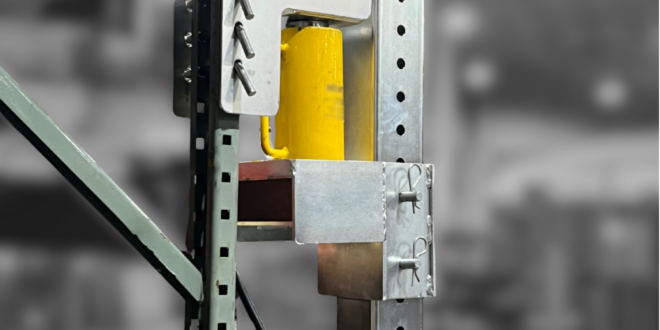
Among the companies advancing this safer approach is SpaceGuard Products, a U.S. manufacturer known for high-strength wire partitions and area guarding solutions. The newest addition to that lineup — the Centurion Primus Jack—was engineered specifically to make rack repair safer, faster, and more adaptable on the jobsite. The device replaces ground level bottle jacks with a modular lifting system that operates directly from the repair zone, giving technicians clear sightlines and precise control.
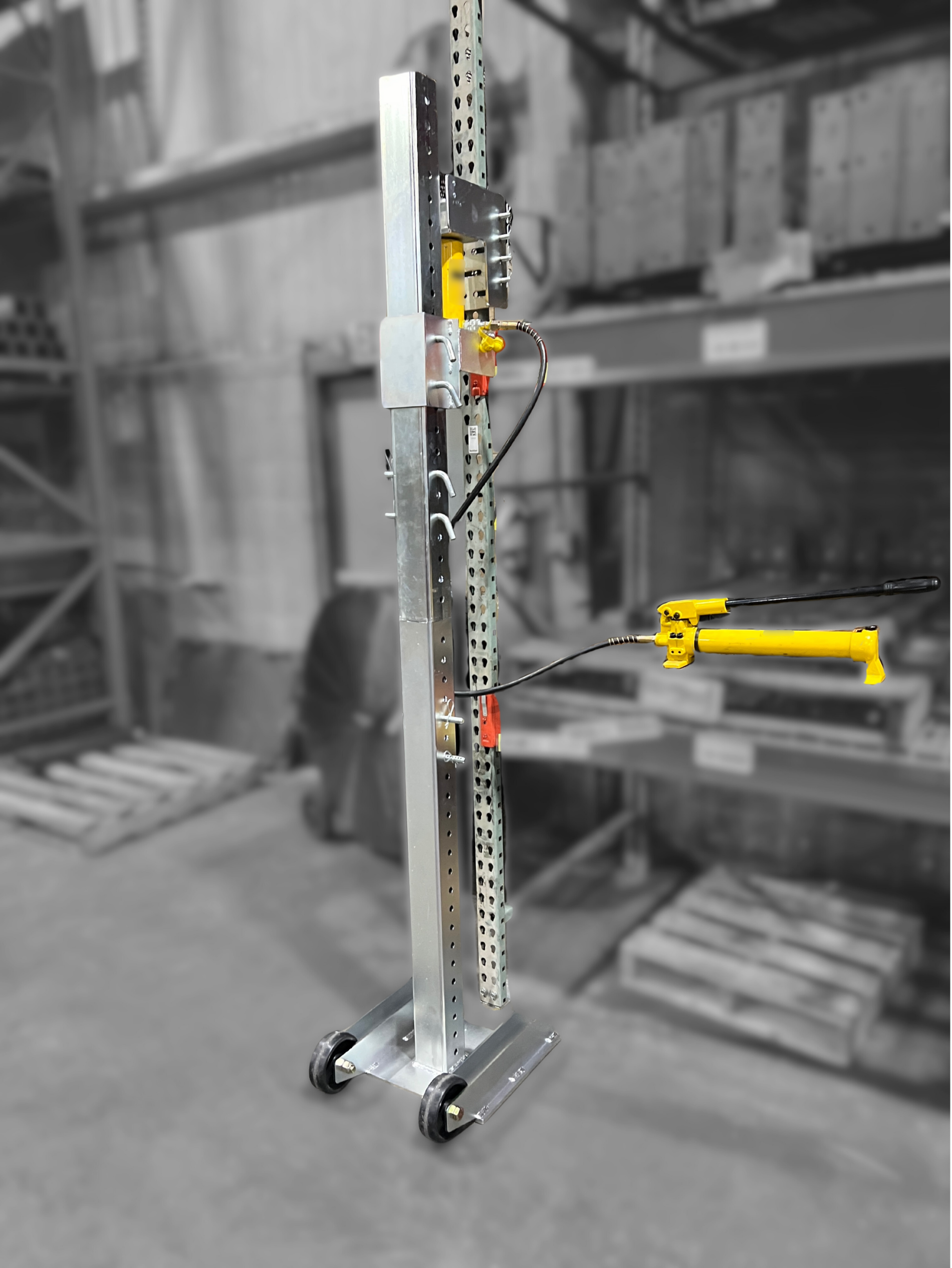
Its two-inch incremental adjustment system and ergonomic pump design allow users to engage from a safe distance while retaining tactile feedback and visual confirmation of lift progress. Operators can raise the rack just enough to relieve the load from the damaged leg — no more, no less — ensuring stability throughout the process.
As rack configurations have diversified, repair tools have had to keep up. No two facilities are identical, beam spacing, frame patterns, and height requirements vary widely, so adaptability has become a defining engineering goal. The Primus Jack’s stackable four-foot extensions demonstrate this shift. Crews can combine or remove sections to match each job, reaching up to thirteen feet for high-bay repairs while keeping the device compact and mobile for transport.
With multiple attachment methods, the Primus Jack accommodates the full spectrum of rack types, including teardrop, structural, keystone, and slide-in ridge designs. For teardrop styles, a quick-swap adapter plate bolts directly to the jack head, providing a simple and secure connection. For teardrop styles, a quick-swap adapter plate bolts directly to the jack head for a simple, secure connection. For structural profiles, the jack head bolts directly to the upright, ensuring a tight, stable fit. A third option, side-pin attachment, offers added flexibility for different configurations. Altogether, this modular design reduces the need for multiple jack models and minimises downtime between jobs, delivering universal compatibility without compromise.
Contemporary rack repair equipment must endure harsh, fast paced environments. Engineers have responded with designs that pair high-strength carbon steel structures with lighter, modular frames. The result is equipment that can withstand years of heavy use while remaining manageable for small crews to reposition.
Ease of operation is another major differentiator between traditional and modern systems. Replacing static lifting tools with a dynamic design, SpaceGuard’s jack head slides securely along the lift column to the exact height needed. The fine-increment adjustment of the Primus Jack allows crews to set up and lift in minutes, reducing preparation time by as much as half compared to conventional equipment.
The shift from reactive to proactive maintenance is reshaping facility operations. As warehouse real estate costs climb, every unused or unsafe bay represents lost value. The ability to repair rather than replace racking is both a cost and sustainability advantage. Modern jacks enable faster, safer repairs that restore functionality with minimal downtime. They also align with a broader emphasis on safety accountability: rather than leaving bent uprights untouched, facilities can now perform timely maintenance without disrupting operations.
Beyond warehousing, these engineering principles are proving valuable in adjacent industries. In the printing sector, for example, a facility used a Primus Jack to lift racks supporting massive paper rolls after impact damage. The technology’s ability to lift from the repair zone itself, instead of from the base, made the repair precise and controlled — a capability that few legacy designs can match.
By integrating modularity, fine adjustment, and ergonomic operation into one durable system, it demonstrates how far rack repair technology has come—and where it’s headed next. As facilities continue to prioritise uptime, worker safety, and responsible asset management, innovations in jack form and function will remain central to raising the standard for what “engineered for the jobsite” truly means.