Engineer News Network The ultimate online news and information resource for today’s engineer
Spectrum Instrumentation introduces its new flagship Arbitrary Waveform Generators (AWGs) with a maximum of six channels at 10 GS/s or 12 channels at 5 GS/s output speed.
The new DN6.63x AWGs belong to the company’s Netbox series, an easy-to-use instrument line that can be controlled via an Ethernet cable from any PC or network.
Utilising high-speed 16-bit DACs, the instruments offer GHz waveform generation with outstanding precision. Designed for engineers and researchers who need multiple synchronized test signals, the new AWGs offer reduced cost and complexity compared to using multiple single-channel generators. With these 10 new variants, Spectrum now offers a total of 47 different generatorNETBOX products, providing arbitrary waveforms from as low as 40MS/s to an ultrafast 10GS/s output rat
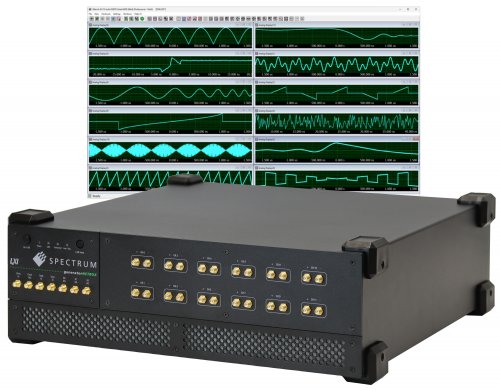
The new DN6.63x AWGs with 16-bit resolution offer up to six channels with 10 GS/s or up to 12 channels with 5GS/s output rate
The DN6.63x instruments feature ultra-low-noise outputs generating signals from DC to 2.5 GHz. With 4 to 12 synchronized channels in one enclosure, Spectrum Instrumentation sets a new benchmark for channel density and cost-per-channel efficiency in high-performance GHz signal generation.
Precision Waveform Generation
All outputs can operate in single-ended or differential mode, with each channel using its own DAC synchronised via a precision PLL system. For even the most demanding test scenarios, the outputs offer:
• Up to 1 Vpp/4dBm into 50Ω or 2Vpp into high impedance
• Noise Spectral Density: –150dBm/Hz
• SNR: up to 6 dB
• SFDR: –90dB
Up to 48 Gigasamples of internal memory are possible, and multiple replay modes (Single-Shot, Loop, FIFO, Single Restart, Multiple Replay) are included for generating long or repetitive sequences.
A Direct Digital Synthesis (DDS) option is available which allows a single channel to output up to 64 individual sine waves, each adjustable in frequency, amplitude, and phase, in steps of only 3.2ns. Up to 384 sine waves in total are possible. DDS provides an easy way to produce waveform trains, sweeps, or fine-tuned references for industrial, medical, imaging, quantum research, semiconductor testing, and communications applications.
For straightforward system integration, front-panel I/O connectors give access to digital marker outputs, trigger and status lines, PLL reference clock, and asynchronous I/O. A digital pulse generator option converts the multi-purpose connectors into independent pulse generators with programmable loops, duty cycle, frequency, and delay.
All Spectrum products include software support for Windows and Linux, with programming examples for e.g. Python, MATLAB, C++, and LabVIEW, plus a high-level Python API. Spectrum’s SBench 6 software, included with every NETBOX, offers an intuitive interface for instrument control, waveform design, and analysis. It features EasyGenerator for standard signals and supports the creation of complex waveforms from equations, imported data (e.g., from digitisers or oscilloscopes), or common file formats such as ASCII, binary, and WAV.
Each generatorNETBOX is ready to use out of the box – simply install the software and start working. The DN6.63x models are available now and include a five-year warranty, free software and firmware updates for the lifetime of the product, and fast support directly from our design engineers
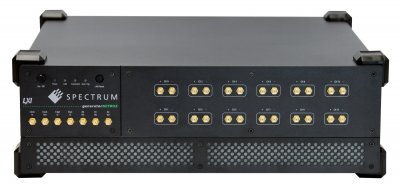
All outputs of the new Arbitrary Waveform Generators can operate in single-ended or differential mode