Engineer News Network The ultimate online news and information resource for today’s engineer
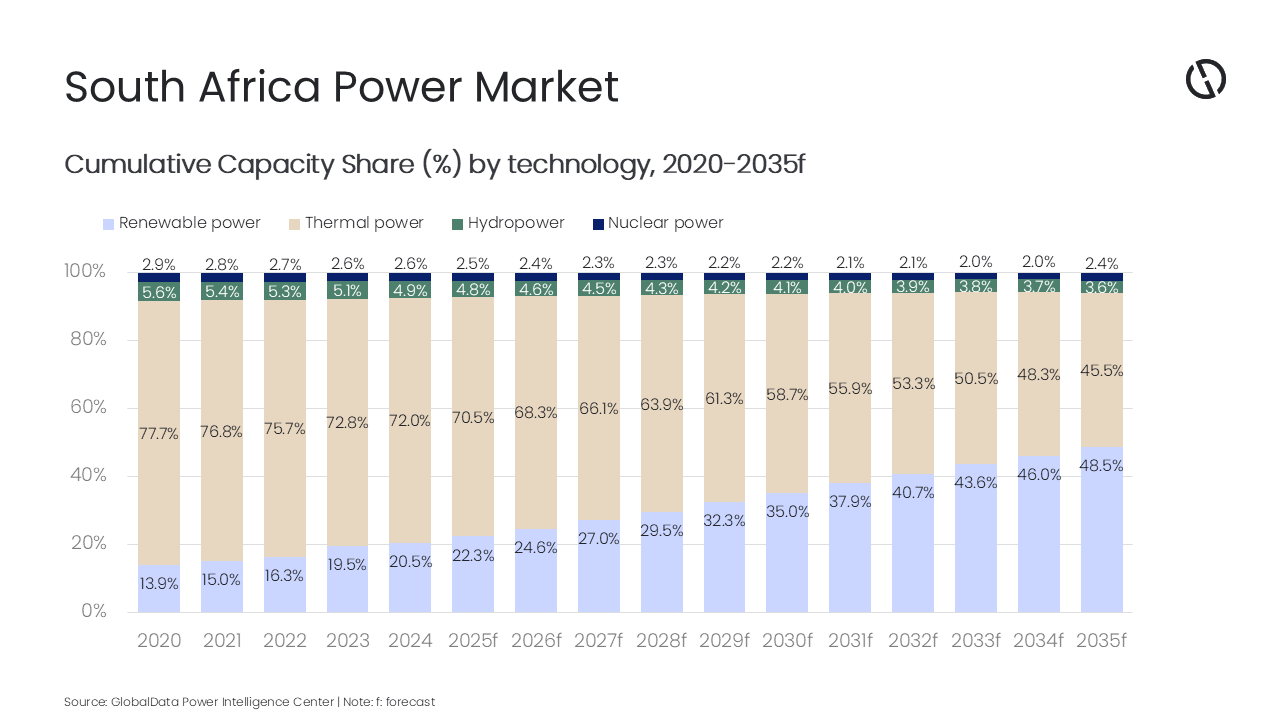
South Africa is accelerating its energy transition, supported by government policy, strong solar and onshore wind potential, and sustainability targets. As a result, the share of renewables is estimated to grow more than double in the South African power capacity mix, increasing from 20.5% in 2024 to 48.5% by 2035, according to GlobalData.
GlobalData’s latest report, South Africa Power Market Trends and Analysis by Capacity, Generation, Transmission, Distribution, Regulations, Key Players and Forecast to 2035, shows renewables are projected to account for 31.3% of the country’s total power generation by 2035, up from 8.9% in 2024. Thermal power represented 72% of total capacity share in the country in 2024.
Sudeshna Sarmah, Power Analyst at GlobalData, comments: “South Africa’s 2024 Electricity Regulation Amendment Act signals a decisive shift toward a more competitive, sustainable electricity market. In tandem, government has fast-tracked new generation capacity, particularly renewables, expanding solar and wind integration to diversify the energy mix and curb dependence on coal.”
South Africa has substantial renewable-energy potential, but inadequate investment has limited its development. Progress has been slowed by delayed bid-window rollouts and weak financial, technical, and procurement planning. Even as new generation projects advance, constraints in Eskom’s grid infrastructure threaten energy security and reliable supply. Modernizing the national electricity system is therefore essential to ensure long-term stability and support economic growth.
South Africa’s Integrated Resource Plan (IRP) targets 6,000MW of solar PV and 14,400MW of wind capacity by 2030. To support these renewable energy goals, several policies and initiatives have been introduced, including the South Africa Renewable Energy Masterplan (SAREM), launched in March 2025 as a strategic framework to strengthen the renewable energy sector, and the Green Fund scheme to finance green initiatives that support a transition to a low-carbon economy.
In addition, the Renewable Energy Independent Power Producer Procurement Programme (REIPPP) is highlighted as a key driver of private-sector investment in grid-connected renewables, helping diversify South Africa’s energy mix through projects such as solar, wind, and biomass, and positioning the country as a renewable energy leader in Africa.
Sarmah concludes: “South Africa’s power sector is undergoing a transition towards sustainable energy, balancing coal retirements with renewable build-out and grid upgrades. While the 2030 target remains ambitious, continued policy alignment, accelerated infrastructure delivery, and greater investment in firming and transmission will be critical to sustaining the country’s clean energy momentum through 2035 and beyond.”