Engineer News Network The ultimate online news and information resource for today's engineer
Switzerland is entering a decisive phase in its energy transition. As the country advances its nuclear phase-out and strengthens its energy security framework, solar PV and storage innovations are set to become essential pillars of the electricity mix through 2030. Without accelerated investment in renewables, flexibility solutions, and streamlined regulation, Switzerland risks supply strains during winter and grid congestion in peak periods, according to GlobalData, the intelligence and productivity platform.
GlobalData’s latest report, Switzerland Power Market Trends and Analysis by Capacity, Generation, Transmission, Distribution, Regulations, Key Players and Forecast to 2035, says solar PV is leading new capacity pipelines and investment flows in the country. While hydropower and pumped storage remain foundational for seasonal balancing, the dynamics are shifting as solar dominates recent auctions and policy incentives.
Attaurrahman Ojindaram Saibasan, Power Analyst at GlobalData, comments: “Switzerland is at a crossroads: with nuclear plants set for a gradual phase-out, the pace and design of renewable deployment, especially solar PV alongside storage and demand flexibility, will determine whether clean energy goals are met while maintaining supply reliability. Investors must scrutinize auction dynamics, permitting timelines, and winter supply policies.”
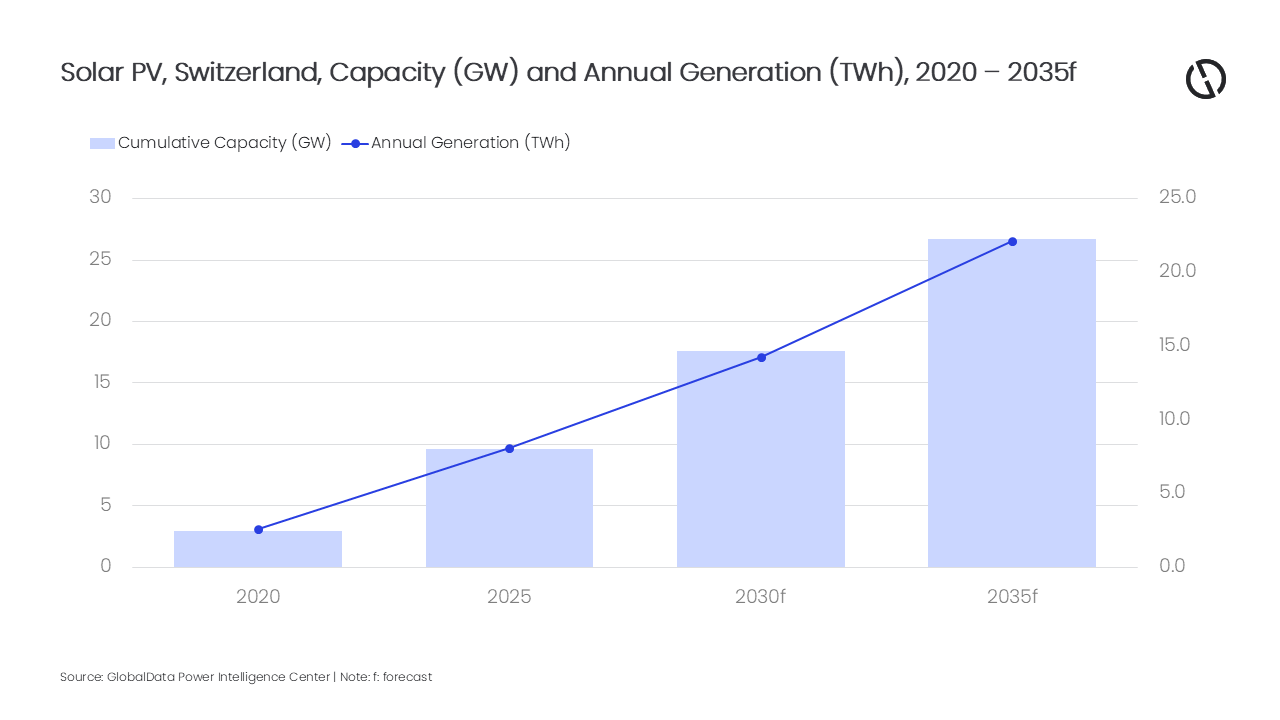
Following the passage of the Federal Act in mid-2024, Switzerland has moved to legally mandate the expansion of renewables, grid resilience, and energy storage. Changes in electricity regulation now require winter reserve capacity and faster approvals for solar and grid projects.
Saibasan adds: “Solar PV investment appears to be outpacing other renewables. Recent incentives are favoring new solar installations over wind or small hydro projects, particularly in alpine zones where winter irradiance may offer better performance. Observed auction outcomes suggest growing variability in bid pricing and some delays in project fulfilment are factors that could delay execution unless addressed.”
Electricity consumption is expected to grow modestly through 2030 under current policies, led by industrial modernization, more electric heating and cooling, and rising uptake of electirc vehicles (EVs) — putting renewed stress on peak demand and infrastructure flexibility. Grid constraints are becoming more visible: distribution networks, especially in mountainous regions, are already approaching capacity limits during high PV output periods, with transformers and lines becoming bottlenecks. Without upgrades or storage, some solar generators may face connection delays or curtailment.
Saibasan concludes: “Regulatory reforms starting January 2026 are set to simplify permitting for small-scale solar and mid-voltage transmission projects. Financial incentives, auction support for winter solar output, and hydrogen strategy pilots are boosting developer confidence. Significant hurdles remain such as local opposition — especially in pristine alpine areas — lengthy appeal and environmental assessment processes, fragmented distribution utility structures that complicate unified grid planning, and uncertain offtake terms for non-solar renewables.”