Engineer News Network The ultimate online news and information resource for today’s engineer
The US operates the world’s largest and most diversified electricity system, supported by abundant domestic energy resources, regional power markets, and a broad technology mix. While federal energy policy since 2025 has increasingly emphasized energy security, domestic manufacturing, and firm generation capacity, long-term power sector investment continues to be shaped by state-level clean energy mandates, utility procurement programs, and private sector demand. Within this framework, renewable energy remains the dominant source of new capacity additions. Against this backdrop, the US is projected to more than double to around 1.06TW by 2035 from around 414.5GW in 2024, reveals GlobalData.
GlobalData’s latest report, United States (US) Power Market Outlook to 2035: Market Trends, Regulations, and Competitive Landscape, shows that renewable power capacity growth in the US is supported by state renewable portfolio standards and clean electricity standards, long-term utility integrated resource plans, and sustained corporate power purchase agreement activity from technology, manufacturing, and data center operators.
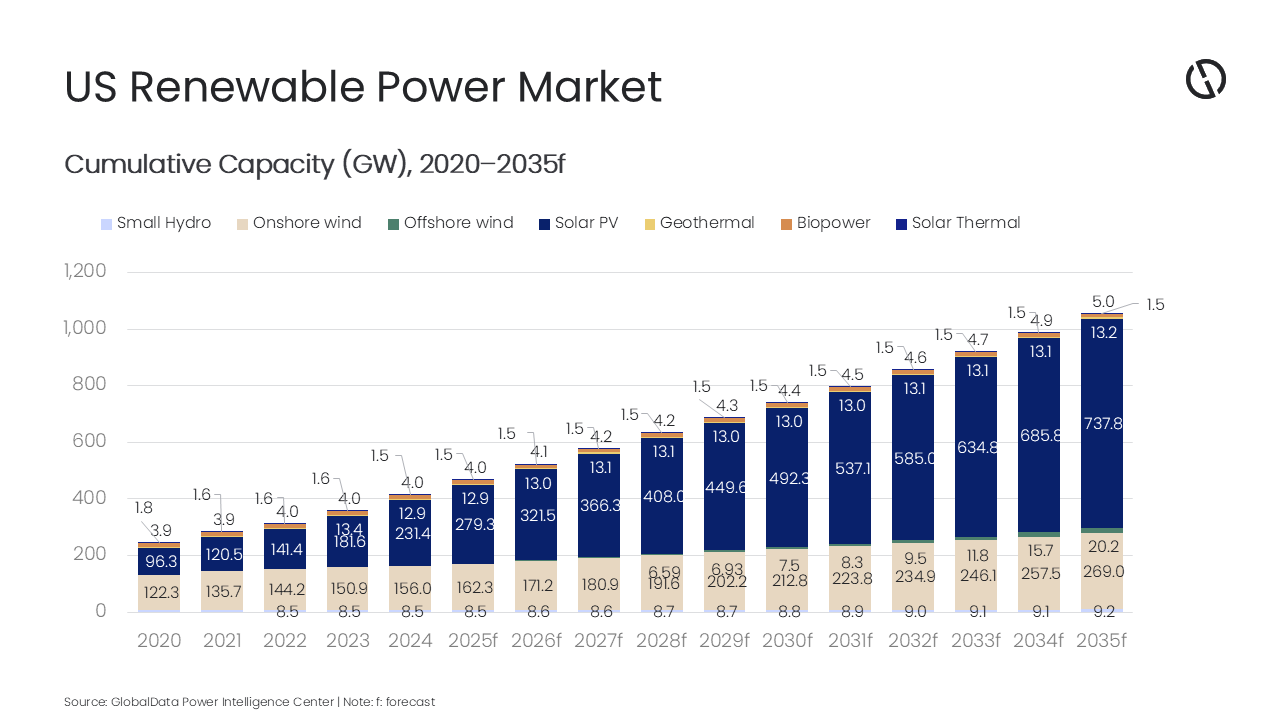
Installed solar capacity in the US is projected to increase from around 231.4GW in 2024 to approximately 737.8GW by 2035, driven by state procurement targets, distributed generation policies, net billing and net metering frameworks, and large-scale utility contracting across key markets such as Texas, California, and the Midwest. Onshore wind capacity is expected to rise from about 156GW in 2024 to nearly 269GW by 2035, supported by long term utility offtake agreements and state level clean energy standards in high resource regions.
Offshore wind development has faced repeated policy and regulatory disruptions since the start of 2025, contributing to sustained uncertainty across the project pipeline. Early in the year, federal authorities ordered a temporary halt to offshore construction activity at Empire Wind 1 off New York in April 2025, despite the project having secured federal and state permits and entered construction.
In August 2025, construction activity at the Revolution Wind project off Rhode Island and Connecticut was briefly suspended following federal intervention, before a court decision allowed work to resume. The operating environment tightened further that same month when the Department of Transportation canceled $679 million in federal funding for offshore wind related port and logistics infrastructure. This sequence of actions culminated on December 22, 2025, when the Trump administration announced the suspension of five offshore wind projects following the halt of federal leasing and project approvals over national security concerns, placing Atlantic coast developments including Vineyard Wind, Revolution Wind, Coastal Virginia Offshore Wind, Sunrise Wind, and Empire Wind on hold and delaying near term capacity additions.
Coal and oil-fired capacity continue to decline as aging plants retire, while natural gas and nuclear power remain integral to the US generation mix. Natural gas capacity is projected to increase from around 573.1GW in 2024 to approximately 620.9GW by 2035, while nuclear capacity to edge higher from about 97GW to around 102GW over the same period.
Mohammed Ziauddin, Power Analyst at GlobalData, comments: “The US power sector continues to attract large-scale investment in renewables, supported primarily by state-level clean energy mandates, long-term utility procurement programs, and sustained corporate power purchase agreement activity. Between 2025-2030, renewable investment is expected to reach around $442.2 billion, reflecting the scale of ongoing solar and wind development across key regional markets. At the same time, continued investment in natural gas and nuclear capacity reflects broader federal and state priorities around domestic fuel availability, industrial growth, and long-term capacity adequacy, including life extensions, and advanced nuclear development.”
Trade and tariff measures introduced in 2025 have added cost pressure and uncertainty across the power sector, particularly for renewable technologies reliant on imported components such as solar modules, wind turbines, batteries, steel, aluminum, and copper. Higher input costs have slowed project timelines, increased capital requirements, and contributed to delays and cancellations across parts of the development pipeline, even as underlying demand for new generation capacity remains strong.
Zia concludes: “Despite policy shifts and tariff-related cost pressures, renewable energy remains the primary driver of capacity growth in the US power sector through 2035. Solar and wind continue to expand at scale, supported by state policies and private sector demand, while gas and nuclear investments address capacity adequacy and longer-term system needs. Together, these trends are reshaping the US electricity system into a more diversified and resilient market over the long term.”