Engineer News Network The ultimate online news and information resource for today’s engineer
China is designing the factory of the future, while Europe, and the DACH region (Germany, Austria, Switzerland) in particular, are struggling with the past. Established IT and OT landscapes as well as fragmented data structures are hampering progress here. Meanwhile, China is taking the lead in terms of supply chain transparency, digital twin technology, automation, and AI. India, Mexico, and the U.S. are also modernizing and implementing things faster than companies in the United Kingdom, for example. In fact, according to companies’ own assessments, the level of digitalization in the UK’s industrial sector has even declined. These are the key findings from the Industry 4.0 Barometer 2026, which the management and IT consultancy MHP has published in collaboration with Prof Dr Johann Kranz from the Ludwig Maximilians University (LMU) Munich.
Bodo Philipp, CEO of MHP Consulting UK Limited in Reading: “Our analysis makes one thing clear: China and the U.S. are driving the transformation of their manufacturing sectors with a strong focus on software and data, while the United Kingdom and the German-speaking markets of Germany, Austria, and Switzerland have yet to build similar momentum. Only 6 and 3% of companies respectively are very familiar with Software-Defined Manufacturing, compared to 30% in China and India. Without the strategic integration of production control, data, and software, it will become increasingly difficult to remain competitive internationally.”
More than 1,200 people from industrial companies were surveyed for the Industry 4.0 Barometer 2026. Specifically, they were asked to assess the status quo with regard to Industry 4.0 in their own companies in the DACH region (Germany, Austria, Switzerland), the United Kingdom, the U.S., China and, for the first time, India and Mexico. The study highlights successes, but also reveals gaps in the subjects surveyed, including supply chain transparency, digital twin technology, Artificial Intelligence (AI), and Software-Defined Manufacturing (SDM).
Degree of digitalisation worldwide rises to 66%, while the UK declines
Internationally, the degree of digitalization ascertained in industry continues to rise, with the overall barometer figure increasing from 48% (2022) to 66% today in all subject areas. However, two regions have fallen significantly behind: The United Kingdom declines to 62% (-2 percentage points compared to the previous year). The DACH region (Germany, Austria, Switzerland) remains stagnant at 57%. Meanwhile, China reaches 72% (+3 percentage points), the U.S. 69% (+3 percentage points), India 68%, and Mexico 67%.
“The degree of digitalisation in industry is increasing worldwide, with Europe also making progress,” said Dr Johann Kranz, Professor of Digital Services and Sustainability at LMU Munich. “In a comparison between countries, however, the U.S. and China are implementing digital production technologies faster and taking a more integrated and scalable approach than European companies. India and Mexico, which we were analysing for the first time, are also showing better results in some cases.”
Causes of the faltering transformation
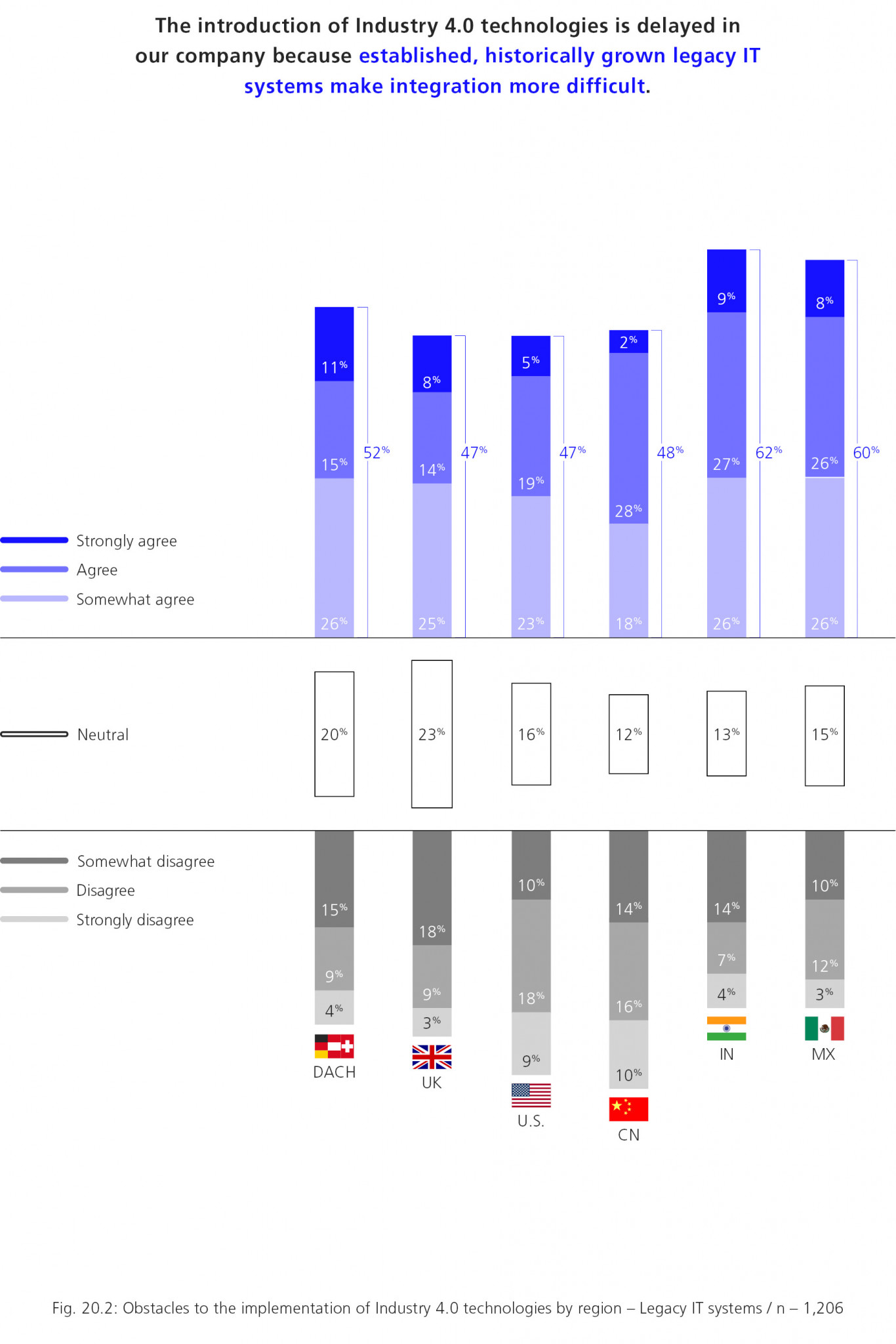
If the digital transformation is being hampered, it is usually due to technical reasons: heterogeneous legacy systems, fragmented data landscapes, and limited interoperability make it difficult to adopt new technologies. By way of example, 40% of surveyed companies in the United Kingdom cite data silos as a barrier, while 47% point to their legacy IT systems. It is a similar picture at companies all over the world. Yet this year’s study reveals that these classic obstacles are overcome at different speeds, particularly in the areas of digital twin technology, Artificial Intelligence, and Software-Defined Manufacturing.
The digital twin is gaining ground faster than other technologies
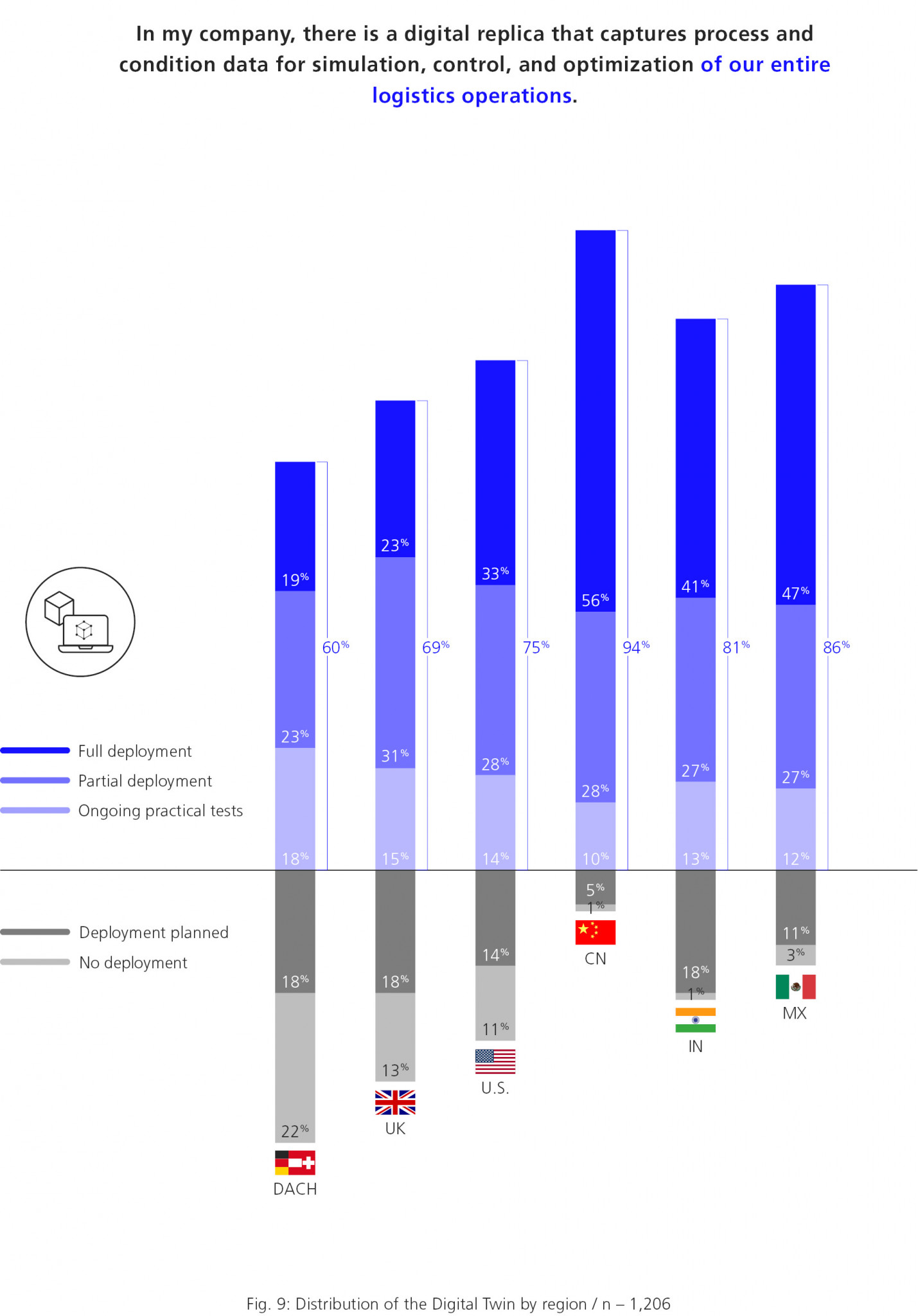
These differences are particularly striking in the case of digital twins. The barometer figure for their use in plants and machines has risen from 54 to 62%, while in logistics it has increased from 61 to 67%, representing the largest jump from the original figure of 30% (2022). This shows that the digital twin is taking off faster than any of the other technologies addressed in the survey.
Across all application fields, China is clearly in a leading position when it comes to the digital twin. This is especially evident in the context of logistics, where 84% of Chinese companies say they partly or fully use this technology. This is followed by Mexico (74%), India (68%), the U.S. (61%), and the United Kingdom (54%), with the German-speaking markets lagging behind on 42%.
AI hype gap: A tangible productivity lever is currently missing
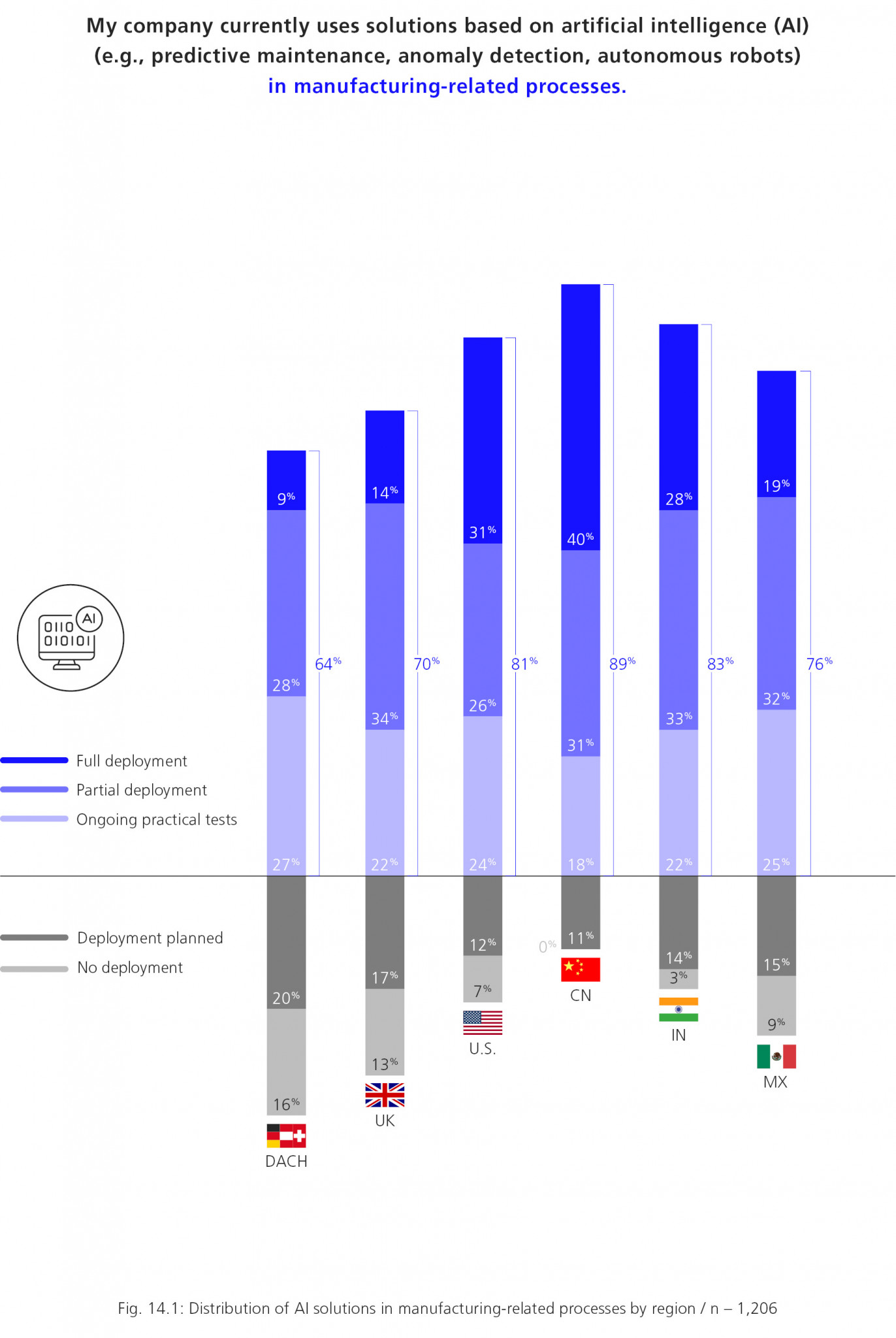
China and the U.S. also take a leading role in the use of Artificial Intelligence in production environments. When partly or fully using AI, Chinese players are out in front on 71%, followed by India on 61%, and the U.S. on 57%. Mexico (51%) and the United Kingdom (48%) are in the middle of the field, while the DACH region (Germany, Austria, Switzerland) is behind on 37%.
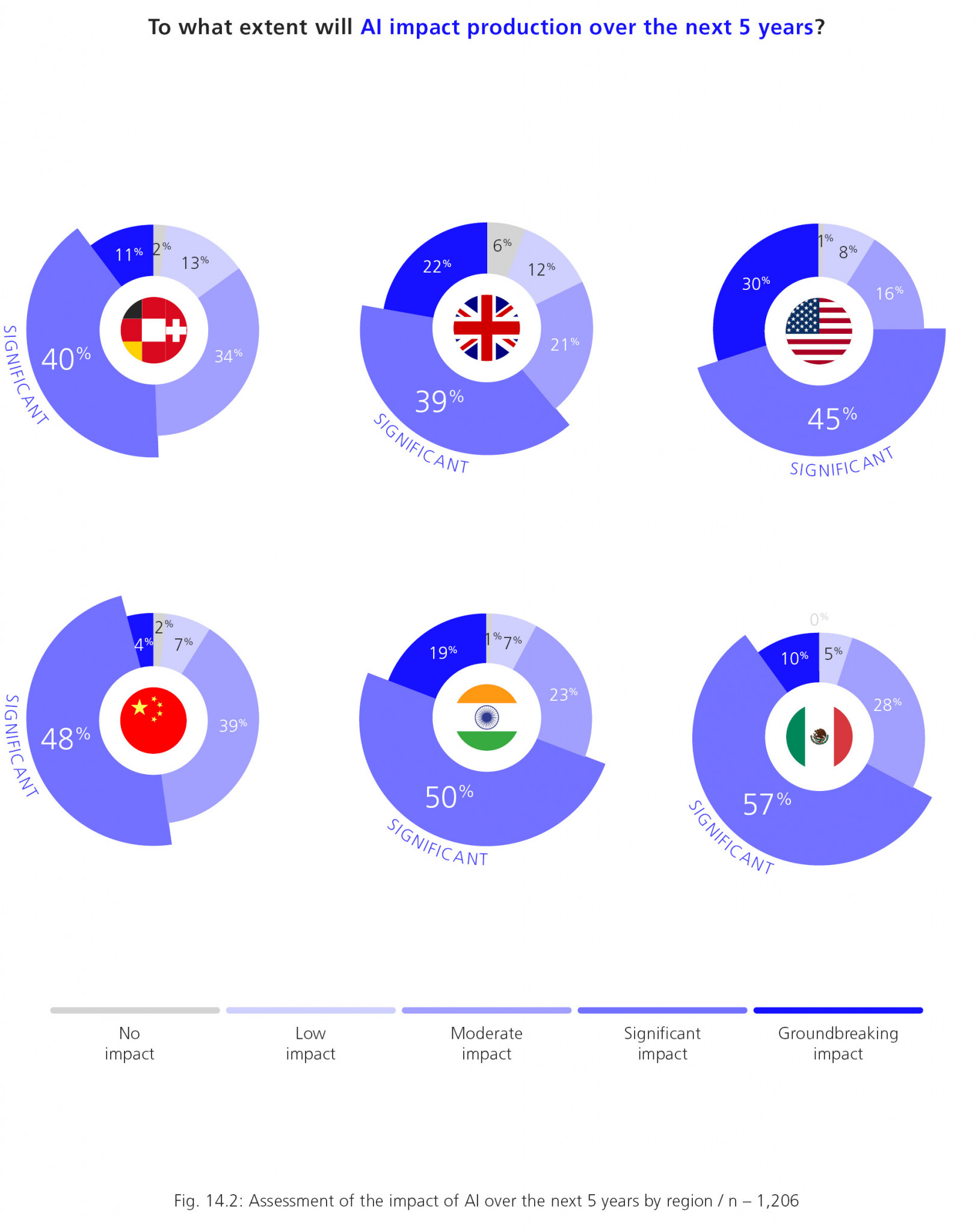
These findings reveal that many European companies are taking a rather cautious approach here. To date, they have only been using AI on a pilot basis, with a lack of deep integration into production processes. At the same time, the future impact of AI is rated highly. By way of example, 61% of companies in the United Kingdom expect it to have a ‘significant’ or ‘groundbreaking’ impact in the next five years. This gap highlights the fact that smart algorithms cannot be productive without solid foundations in terms of data infrastructures, sensor technology, and digital twins. Accordingly, AI remains a future promise in industrial practice but will not become an effective productivity factor (‘AI hype gap’).
Software-Defined Manufacturing (SDM) is the new key skill
SDM separates production control from physical hardware and creates a central software layer that makes the manufacturing process flexible and scalable across different sites. CIOs play a key role here by becoming architects of the digital factory and taking responsibility for IT/OT integration, data literacy, and investment prioritisation. Companies with a CIO state much more frequently that they are familiar with the SDM concept (+33.2%) and are more likely to integrate it into their overall strategy (+18.4%). There is also a greater propensity to invest (+13.8%), while the proportion of the budget earmarked for maintenance expenses is lower (-26.2%).
When comparing familiarity with the still nascent SDM concept, India and China are blazing a trail, with 30 percent of respondents in each of these countries attesting to a ‘very high’ level of familiarity. The proportion is significantly lower in the United Kingdom (6%) and in the German-speaking markets (3 percent). The U.S. (14%) and Mexico (18%) are in the middle of the field.

Further upheavals are expected
The majority of respondents worldwide expect significant upheavals in the next ten years as a result of digitalization and software-driven approaches, with 31% holding the firm belief that their industry will undergo fundamental change and another 51% considering it likely. Once again, there are considerable regional differences in this assessment. In India, for example, 44% of respondents are convinced that software-driven approaches are altering their industry, while the figure in the United Kingdom is only 17%.
Digitsation requires a real willingness to invest: 71% of respondents in India state that their companies are willing to spend significant sums of money on new digital technologies. Mexico (65%) comes next, followed by the U.S. (59%). The figure is critical for the United Kingdom, where just 36% are willing to invest. Only the DACH region (Germany, Austria, Switzerland) is scoring lower at 29%.
“European companies are focusing on efficiency and cost optimisation, which means that strategic potential for growth, flexibility, and innovation often remains untapped,” explained Prof. Christina S. Reich from FOM University of Applied Sciences, who is also a manager at MHP. “Emerging markets such as India, China, and Mexico, meanwhile, are pursuing more differentiated strategic goals. India, for example, is specifically focusing on improving quality due to its historical competitive position and global pressure. The aim here is to meet international standards and open up new markets.”
Overall, the findings highlight the fact that Europe is facing a huge modernisation task. The main way for companies to maintain their competitive ability on the international stage lies in breaking down the technical barriers, standardising IT/OT structures, and consistently gearing production toward software-based, scalable architectures. Software-Defined Manufacturing is becoming a yardstick for future industrial viability – and a critical success factor in the context of Industry 4.0.
About the Industry 4.0 Barometer 2026
The Industry 4.0 Barometer has been published since 2018 by the management and IT consultancy MHP in cooperation with Prof. Dr Johann Kranz from Ludwig Maximilians University (LMU) Munich. The 2026 edition analyzes the statements of 1,206 people from industrial companies in the DACH region (200), the United Kingdom (202), the U.S. (200), China (200) and, for the first time, India (200) and Mexico (204). The most strongly represented sectors are mechanical and plant engineering and information and communication technology, each with 13%, followed by the automotive industry (10%t). The participants have roles across all hierarchical levels, most frequently working in IT (23%) and production (24%).
The questionnaire covers four areas – technology, IT integration, strategy, and goals – while equally examining barriers and drivers.
MHP Consulting is Porsche-owned, and is a leading global consulting firm that specialises in strategy, digital transformation, and performance improvement across various industries, including automotive, manufacturing, and technology.