Engineer News Network The ultimate online news and information resource for today's engineer
As wastewater and stormwater requirements become more demanding, the most important part of a separator is often the part most people never see. Walt Stein explains
For civil engineers, mechanical engineers, owners, and municipalities, wastewater pretreatment is usually evaluated by what it can keep out of downstream infrastructure. In a vehicle maintenance facility, that may mean preventing oil, grit, and hydrocarbons from entering the sanitary sewer. In a car wash, it may mean removing enough solids and petroleum-based contaminants to make reclaim water suitable for reuse. In a stormwater application, it may mean capturing sediment, trash, and free oil before runoff reaches a body of water or municipal drainage system.
Although these applications are different, the design solution is similar: water must be slowed, controlled, and directed through a treatment process that provides a realistic means to separate contaminants. A tank alone does not accomplish that. Rather, the internal arrangement of baffles, chambers, storage zones, coalescing and/or filtration media, and bypass features within a tank, combined with maintenance access points, controls, and alarms, is what determines whether a pretreatment system can perform effective separation consistently over time.
As pretreatment expectations rise, many stormwater projects now target 80 percent total suspended solids (TSS) removal, while some applications require low concentrations of oil, grease, or petroleum-based hydrocarbons in discharged water. Industrial users may also be required to test and document their runoff quality. In such an environment, the old assumption that a traditional baffle box can achieve treatment goals is becoming harder to defend.
Why separation depends on flow, distance and time
Most oil-water and sediment separation systems are based on a simple principle: when water slows down, heavier particles can settle while lighter oil droplets can rise. Traditional baffle tanks use this principle by spreading flow across a larger chamber and reducing velocity. The limitation here is distance. In a conventional tank, a particle or droplet may need to travel several feet before it reaches the bottom of the tank or the water surface. If the tank is large enough and the flow is calm enough, separation can work well. But large tank treatment footprints are not always practical, especially in constrained commercial, industrial, or urban sites. Flow conditions can also change. A higher-flow event may increase velocity and greatly reduce separation efficiency, re-suspend previously captured sediment, or re-entrain oil and floatables into the discharged treatment stream.
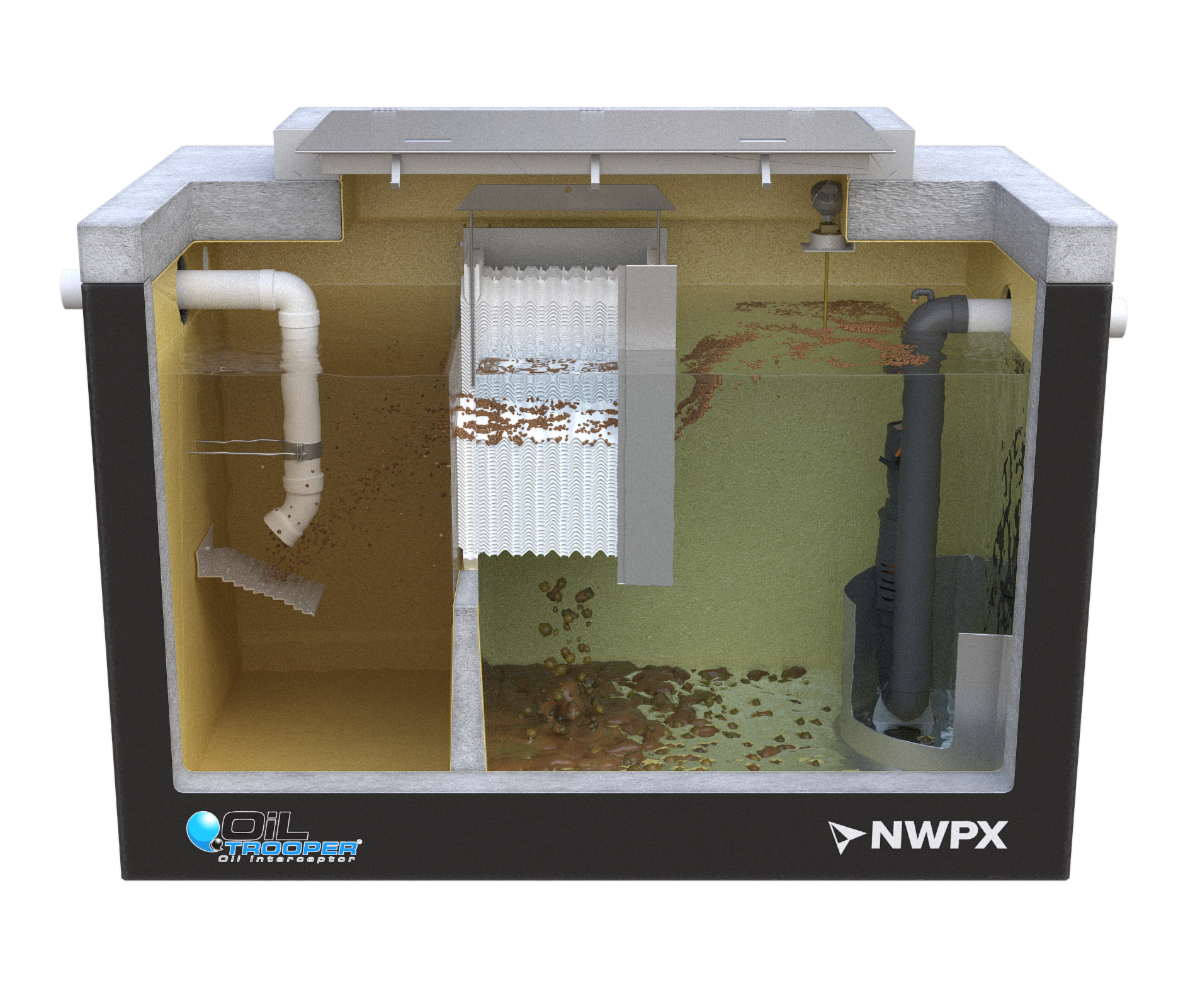
Coalescing media plates address this problem by reducing the rise and fall distances a droplet or particle must travel before it strikes a surface. Instead of relying only on the bottom of the tank or the surface of the water, a series of closely spaced corrugated plates is placed within the flow path. Oil droplets adhere to the plate media, merge into larger droplets, and separate more readily. Fine solids also have more opportunities to strike a plate and fall from the active flow path.
The corrugated plate design further enhances separator performance by creating a serpentine flow path that forces water through a more deliberate path rather than allowing it to short circuit across an open chamber. As a result, greater separation efficiency can be achieved without requiring an oversized tank.
Matching internal design to the waste stream
A separator designed for oil laden washdown water does not face the same conditions as a stormwater unit serving a parking lot drainage area. Effective pretreatment depends on matching internal design to the specific waste stream.
Multi-chamber baffling can help spread incoming flow and reduce turbulence before water reaches the coalescing media pack. When the flow is forced through the media, small oil droplets and finer solids have a better chance of separating. A dedicated deposition zone below the media is critical as captured solids should not be stored directly within the treatment flow path. If accumulated material blocks the active flow area, velocities can rise and previously captured pollutants may be stripped back into the water.
Car wash reclaim systems require a broader treatment train because the goal is not only discharge compliance but reuse. Wash water carries sand, dirt, soaps, oils, and other material removed from vehicles. If those solids are returned to high-pressure spray equipment, they can affect wash quality and potentially damage vehicle finishes.
For this reason, car wash reclaim treatment generally begins with velocity control and coarse solids capture. A series of baffled concrete tanks allows heavier material to settle while clarified water continues through the system. The effectiveness of additional treatment steps, such as filtration, reverse osmosis polishing or possibly ozone disinfection, depend on strong pretreatment upstream. Fine filtration and polishing technologies perform best when the heaviest grit, sludge, and oil load are removed at the front end of the treatment train. A good reclaim system is therefore not a single piece of equipment but a staged flow path, with each chamber within the treatment train protecting the next.
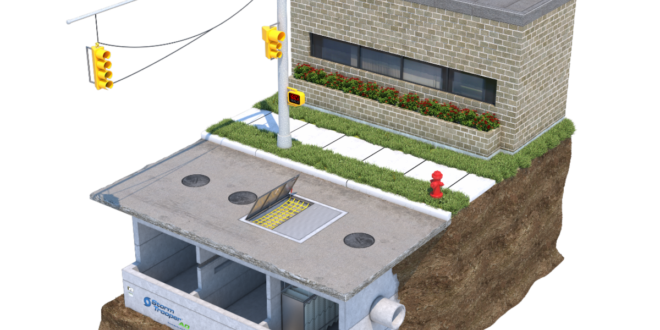
Stormwater systems introduce another variable: unpredictable flow rates. During a storm, runoff can quickly increase from low to high flow, and the first flush often carries a large share of pollutants from paved surfaces, industrial yards, fueling areas, or commercial sites. Treating every gallon from a major storm event can be impractical, but allowing high flows to scour a treatment unit can undermine performance. This is why diversion structures, weir walls, trash screens, and bypass features are so important. They help route the water quality flow through the separator while allowing excessive flows to bypass the treatment chamber, reducing the risk that captured pollutants will be washed downstream.
Compliance is also a maintenance problem
Pretreatment systems are often judged by their initial performance, but long-term success largely depends on maintenance access. Any system that captures sediment, oil, trash, grit, or sludge will eventually need to be cleaned. If access is difficult, unsafe, undersized, or poorly located, maintenance is less likely to happen on the schedule the system requires.
This is one of the practical reasons internal design should be evaluated alongside exterior footprint and rated capacity. A coalescing media pack that can be removed, cleaned, or accessed is very different from one buried in a configuration that makes recovery difficult once solids accumulate. A hatchway that can withstand traffic loading while still allowing service crews to easily reach the treatment area is not a secondary detail. It directly affects whether the asset can keep performing after the first year, the first major storm, or the first period of heavy use.
Monitoring features can also support compliance by making maintenance less dependent on guesswork. In oil-water separation, sensors and alarms can indicate when the oil level has reached a point that requires service. More advanced control panels can communicate system status, capacity, or high oil conditions to operators, and some systems can be tied into building automation systems. In spill control applications, an oil-stop valve can provide another layer of protection by shutting off discharge when a significant petroleum layer is present.
These features do not eliminate maintenance. They make maintenance more visible and manageable. That distinction is important for owners who are trying to control lifecycle cost. A lower maintenance system is not one that never needs attention; it is one that captures contaminants predictably, stores them outside the active treatment path where possible, and gives operators a clear signal and access when service is required.
A co-ordinated approach to pretreatment design
As treatment requirements become more specific, manufacturers are being asked to do more than supply a standard tank. Engineers and owners often need help determining the right flow rate, storage volume, media configuration, access layout, alarm package, and maintenance approach for a particular site. From a fueling area to a fire station, varying sites may all require separation technology, but they do not require the same exact system.
NWPX Park’s OilTrooper, HydroRecycle, and StormTrooper systems offer an example of how a coordinated family of pretreatment solutions can apply shared separation principles across different applications. OilTrooper uses multi-chambered baffling, a Coalescing Media Pack, sensors, alarms, and spill-control features to separate sand, grit, oil, and hydrocarbons from wastewater before discharge. HydroRecycle applies staged gravity flow treatment to car wash reclaim water, using baffled precast tanks, oil-water separation, ozone treatment, and optional reverse osmosis to support reuse. StormTrooper uses a hydrodynamic separator layout with a control manhole, weir wall, trash screen, bypass function, and coalescing plate technology to treat first-flush stormwater while protecting the system from high flow events.
One notable development is NWPX’s move to manufacture its coalescing media packs in house. This shift to vertical integration gives the company greater control over quality, availability, scheduling, and design coordination. It also allows the media pack to be tailored more closely to the end use, whether the application requires different plate spacing, a specific flow per square foot of media plate capacity, or adjustments based on the expected pollutant load.
That flexibility matters because pretreatment rarely succeeds as a ‘one-size -fits-all’ exercise. The best designs start with the actual site conditions and estimates of the expected flow rate, solids load, oil concentration, droplet size, water temperature, available footprint, maintenance schedule, and discharge requirements. From there, the system can be configured to support both treatment performance and long-term operation.
Better internals create better outcomes
The future of pretreatment will be shaped by the simple reality that regulators, municipalities, and owners are paying closer attention to what leaves a site. It is no longer enough for a system to simply provide a large storage volume in the ground. These systems must control flow, protect captured material, support maintenance, and produce a predictable effluent quality under real operating conditions.
Advanced internals make that possible. Coalescing media reduces the travel distance required for oil and fine solids to separate. Baffled chambers reduce velocity and create staged treatment. Dedicated storage zones prevent captured material from interfering with the active flow path. Diversion and bypass structures protect stormwater units during high flow events. Sensors, alarms, and accessible hatches make maintenance more visible and more likely to occur when needed.
For engineers and owners, the takeaway is practical: evaluate the inside of the system as carefully as the outside. Capacity, footprint, and installation cost still matter, but they do not tell the whole story. The real measure of value is whether the system can keep separating pollutants, protecting infrastructure, and supporting compliance over the life of the site.
Walt Stein, P.E., is Regional Sales Engineer at NWPX Infrastructure.