Engineer News Network The ultimate online news and information resource for today's engineer
Asia is set to lead the global acrylonitrile industry capacity additions with a share of 99.6% by 2026 from new-build projects between 2022 and 2026, forecasts GlobalData, the data and analytics company.
GlobalData’s latest report Acrylonitrile Industry Installed Capacity and Capital Expenditure (CapEx) Forecast by Region and Countries including details of All Active Plants, Planned and Announced Projects, 2022-2026 shows that the total acrylonitrile capacity addition in Asia is expected to reach 2.49 million tonnes per annum (mtpa) by 2026.
Nivedita Roy, Oil and Gas Analyst at GlobalData, comments: “Asia is expected to gain the total estimated acrylonitrile capacity additions from 10 new-build planned projects. The capacity additions will be driven by an increase in acrylonitrile consumption in textile and garment industries, where there is a growing need for acrylic fibres.”
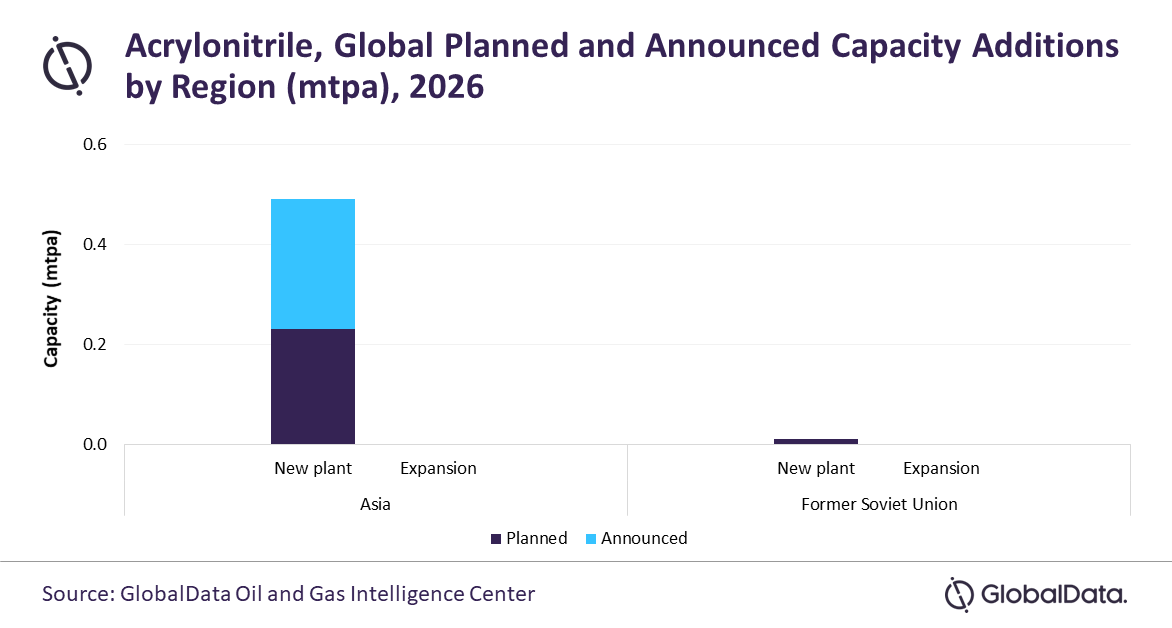
China is the major country in Asia in terms of acrylonitrile capacity additions. The main capacity additions in the country would be from five planned projects.
With a capacity of 0.26 mtpa each, the projects include Hengli Petrochemical New Material Dalian Acrylonitrile Plant, Jiangsu Sailboat Petrochemical Lianyungang Acrylonitrile Plant 2, Jiangsu Sailboat Petrochemical Lianyungang Acrylonitrile Plant 3, Jinneng Science & Technology Company Qingdao Acrylonitrile Plant, and Shandong Yulong Petrochemical Longkow Acrylonitrile Plant.