Engineer News Network The ultimate online news and information resource for today's engineer
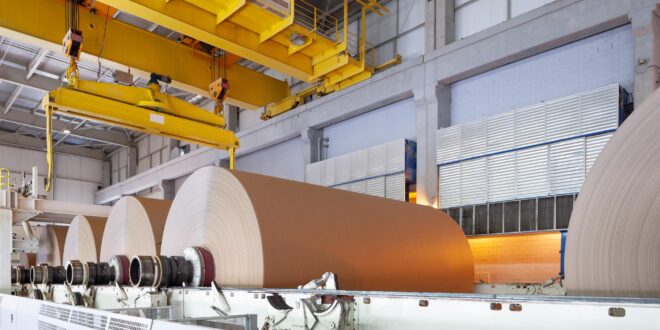
In pulp and paper manufacturing, compressed air is not just a supporting utility, it is a production-critical system. From fibre preparation and chemical dosing to drying, finishing, and automated packaging, stable, clean and dry compressed air directly impacts uptime, quality and energy performance. Atlas Copco, manufacturer of electric E-Air compressors designed for demanding industrial environments and applications, shares key considerations for mills looking to improve reliability and reduce total cost of ownership.
Demanding conditions
Pulp and paper plants combine high humidity, chemical exposure and continuous 24/7 operation: conditions that accelerate corrosion, increase the risk of condensation in air systems, and intensify wear on components. Moisture and contamination in compressed air can lead to valve issues, corrosion damage and unstable pneumatic control, with consequences ranging from quality deviations to pricy unplanned downtime.
At the same time, many critical applications such as vacuum systems, air knives, web stabilisation, actuators, conveyors and automation all depend on consistent pressure and flow. Even brief pressure drops can contribute to sheet formation instability, web breaks, or disruption to dosing and control systems.
Three essentials
It is important to keep in mind three essential things when operating with compressed air in pulp and paper manufacturing.
First of all, air quality must be engineered for humid and corrosive zones specifically. Clean and dry compressed air helps protect pneumatic control systems and machine components in challenging areas such as digesters, bleaching lines and dryer sections. That is why Atlas Copco recommends solutions built around robust inlet filtration, appropriately sized dryers and corrosion-resistant components to reduce the risk of condensation-related failures.
Second, reliability should be built in by design. Pulp and paper environments require compressor systems that can withstand wide temperature fluctuations and exposure to corrosive or damaging atmospheres. Features such as sealed designs, durable coated or stainless components, advanced filtration and optimised cooling help deliver stable performance and predictable maintenance.
Third, energy efficiency needs to be treated as a total cost of ownership lever, not an afterthought. Compressed air is one of the largest utility expenses in pulp and paper manufacturing. Atlas Copco points to technologies such as variable speed drive (VSD) , heat recovery and optimised cooling as proven ways to reduce electricity consumption, especially in 24/7 mills where savings accumulate quickly over time.
“Pulp and paper mills operate in though conditions for compressed air: high humidity, chemical exposure and constant production demands,” says Panagiotis Papaioannou, Product Manager at Atlas Copco. “When air quality and pressure stability aren’t engineered for that reality, you don’t just risk higher maintenance costs, you risk process instability on the paper machine and quality fluctuations. The right compressor set-up, with the right air treatment and energy controls, helps mills protect critical equipment while lowering long-term energy costs.”