Engineer News Network The ultimate online news and information resource for today's engineer
Marten Jurg looks at risk-based quality in metal AM, and analyses how to blend in-situ evidence with smart inspection strategies
Metal additive manufacturing has a quality problem, but not the one people think. The industry does not lack inspection methods. It lacks a credible, scalable inspection strategy. Too many teams are still trying to ‘buy certainty’ the same way they did in traditional manufacturing, inspect more, test more, document more. In metal AM, that instinct is understandable, and often self-defeating.
Because if your path to confidence is a growing stack of post-build inspection, you have not solved quality. You’ve simply moved the bottleneck downstream and called it governance.
Here is the uncomfortable truth, 100% post-build inspection is not a quality strategy. It is a tax on learning and a brake on scale. It is also the fastest way to make metal AM look uneconomic the moment parts become larger, denser, more valuable, or simply more urgent.
A more mature approach is risk-based quality, use the right evidence at the right time, at the right cost, to control the right risks. That means blending in-situ evidence with targeted inspection, so quality becomes a production capability, not a post-processing ritual.
The real question is not ‘Can you detect defects?’ It is ‘What decisions can you justify?’
If you work in regulated production (especially aerospace, defence, energy, or medical) you have probably sat through the same debate in different clothes:
- In-situ monitoring looks interesting, but can we trust it?
- CT is trusted, but it is slow and expensive.
- Coupons help, but they do not prove the part.
- We need traceability, but we are drowning in data.
These are not technical questions. They are decision questions. And the way to answer them isn’t to choose one method and declare victory, it’s to build an evidence ladder that matches risk.
Risk-based quality starts with a simple hierarchy
Think of AM quality evidence in four layers:
- Design intent and criticality. What failure modes matter? What features are safety-critical, load-bearing, pressure-retaining, fatigue-sensitive, or mission-critical? If you cannot rank risk, you cannot rank evidence.
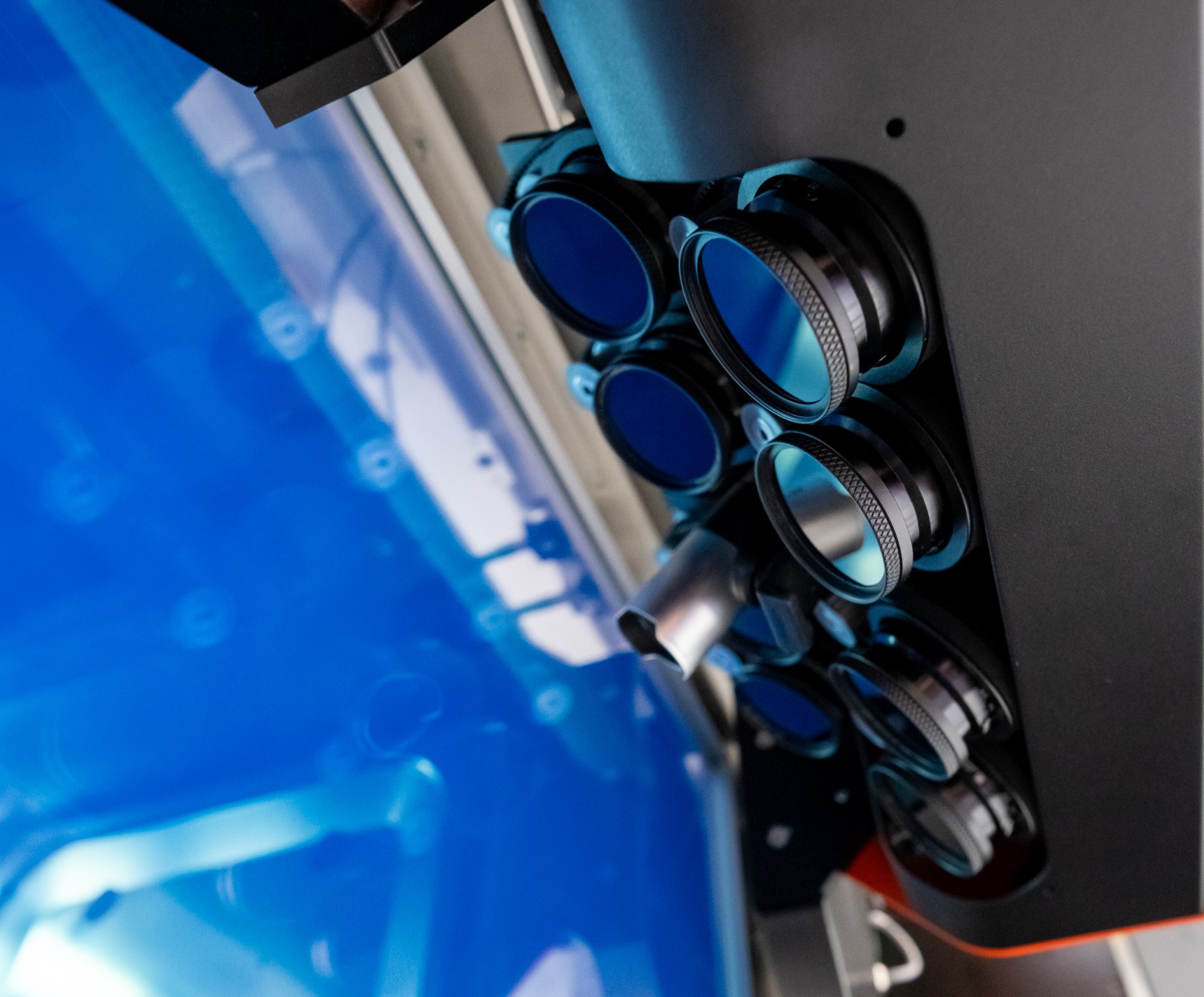
- Process evidence (in-situ). What happened during the build (layer by layer) and does it remain within defined acceptance criteria? Process evidence is powerful because it is early and complete across the build, not sampled after the fact.
- Targeted verification (inspection and test). Where do you need direct measurement (CT, CMM, metallography, density, tensile, fatigue, surface inspection) and how often? Verification should confirm and calibrate your process evidence, not replace it wholesale.
- Governance and traceability. How is the evidence packaged so Quality, Certification/Regulatory, and customers can actually review it? More data is not traceability. Traceability is structured proof.
Most organisations overinvest in layer 3 because it is familiar. They underinvest in layer 2 because it feels new. And they ignore layer 4 until an auditor asks the question that ruins everyone’s week. Risk-based quality fixes that imbalance.
Why in-situ matters
Post-build inspection tells you whether the part finished in a certain state. In-situ evidence tells you whether the part became that state, and when. That shift matters for three reasons:
- Early truth is cheaper truth. The earlier you discover deviation, the less waste you accumulate in machine time, powder, post-processing, and opportunity cost.
- Complete coverage beats selective sampling. Many inspection strategies rely on sampling, coupons, partial scans, periodic checks. In-situ evidence can cover the full build, continuously.
- Root cause becomes tractable. When you can link anomalies to layer/time/region, you can move from ‘we found a problem’ to ‘we know when it happened and what it correlates with’.
In-situ does not eliminate inspection. It makes inspection smarter and defensible.
The false binary: ‘either CT or in-situ’
You do not need a war between CT and in-situ. You need a calibration relationship. In a risk-based programme, CT can be used as:
- a baseline validator during early qualification,
- a periodic audit tool once the process is stable, and
- a triggered investigation when in-situ evidence indicates increased risk.
This is how mature quality systems work everywhere else. You establish correlation, prove detectability, and then scale with a rational sampling plan. The goal is not ‘never CT’. The goal is CT where it buys down risk most efficiently.
When organisations insist on ‘100% CT forever’, they’re often compensating for a lack of confidence in process evidence. That is a solvable problem, but it requires treating in-situ evidence like quality evidence, not like a dashboard.
What ‘good’ in-situ evidence looks like in a regulated context
For Quality and Certification stakeholders, ‘good’ is rarely ‘more’. It is ‘clearer’. Good in-situ evidence should be:
- Decision-ready: it supports a disposition (proceed, hold, audit, investigate) without requiring a PhD to interpret.
- Traceable: it ties back to part identity, build parameters, and acceptance criteria.
- Comparable: it enables ‘this build vs known-good’ thinking, drift detection, fleet consistency, and change control.
- Governable: it can be deployed in a way that IT/Security can defend (access control, retention, audit logs, storage planning).
- Validatable: it can be correlated to physical outcomes (CT, metallography, mechanical testing) so decisions aren’t faith-based.
This is the core shift in Phase 1 of any serious adoption journey: from monitoring to assurance.
The inspection strategey you actually want
A pragmatic, risk-based inspection strategy often evolves through three stages:
Stage 1 — Establish correlation (qualification reality)
Use CT and other inspection methods deliberately to map in-situ signals to physical outcomes. Define acceptance thresholds and confidence levels. Create your evidence pack.
Stage 2 — Transition to risk-based auditing (production reality)
Reduce blanket inspection where correlation and stability justify it. Increase targeted checks where risk remains high (new geometries, new machines, parameter changes, new powder lots, maintenance events).
Stage 3 — Manage drift and change (scale reality)
Use in-situ evidence to detect drift early, maintain consistency across machines and lasers, and manage change control without requalifying the universe every time something shifts.
This is not less quality. It is more disciplined quality.
A slightly provocotive closing thought
If your quality system depends on inspecting problems out of the part at the end, you have accepted a fragile process. You are not scaling AM, you are managing anxiety.
Metal AM will only become truly industrial when we treat quality the way high-performing manufacturing always has, as process control plus verification, not verification alone. In-situ evidence — done properly — does not compete with your QMS. It strengthens it. It gives Quality teams earlier, richer, and more defensible evidence, and it gives Operations teams a chance to intervene before cost accumulates.
If you’re building an inspection strategy right now, and you are feeling the gravity of lead times, cost, and audit pressure, start with one question. ‘Which decisions do you want to make earlier, with more confidence, and at lower total cost?
That is the beginning of risk-based quality.
Marten Jurg is Co-founder & CEO, Additive Assurance.