Engineer News Network The ultimate online news and information resource for today's engineer
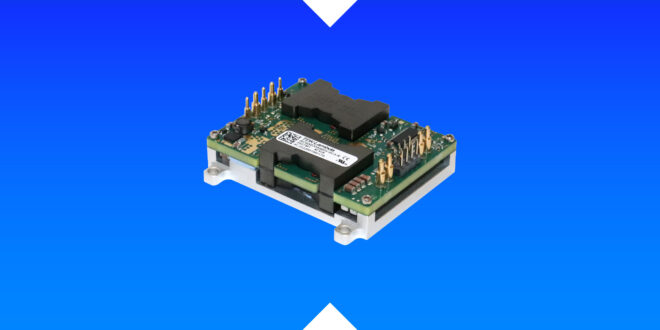
TDK Corporation announces the launch of the TDK‑Lambda i9C series, a 1500 W non‑isolated DC‑DC buck‑boost power module designed to maximise system efficiency, reduce thermal stress, and extend battery runtime in demanding industrial and battery‑powered applications. The i9C series launches with a 9–80V input, 9.6–60V output model delivering up to 30A. A second configuration supporting a 9–40V input range with 5–36V output and up to 50A is planned to follow, expanding the series’ voltage and current options.
At the core of the i9C series is TDK-Lambda’s programmable high-efficiency pass-through (PHEPT) technology. PHEPT allows designers to define an input-voltage window in which the module bypasses regulation and directly connects the input to the output, eliminating switching and conversion losses. When operating in this mode, efficiency can reach up to 99 %, significantly reducing heat generation and improving system reliability for engineers, particularly those designing battery-powered systems.
The i9C is packaged in a compact, wide quarter‑brick form factor with an integral baseplate that supports convection, conduction, or forced‑air cooling, making it well suited for high‑ambient, low‑airflow environments. Standard control and protection features include negative‑logic on/off control, power‑good, remote sense, user‑adjustable overcurrent protection, low‑power sleep mode, and full auto‑recovery protection. The user-configurable sleep mode programs the power module into a low-power dissipation state during idle or light-load conditions. The adjustable overcurrent protection reduces stress on both the power module and load and helps engineers reduce or eliminate external circuitry.
The i9C series is designed for use in industrial, communications, test and measurement, and battery-powered applications, including AGVs, AMRs, commercial drones, and humanoid robotics. The modules are certified to IEC/UL/CSA/EN 62368‑1 safety standards and carry CE and UKCA markings for the Low Voltage, EMC, and RoHS Directives.