Engineer News Network The ultimate online news and information resource for today's engineer
Across the United States, municipalities are grappling with the same challenge: aging wastewater infrastructure and shrinking maintenance budgets. The American Society of Civil Engineers (ASCE) gave the nation’s wastewater systems a D+ on its most recent infrastructure report card, citing overflows, infiltration, and corrosion as critical weaknesses. Many cities face mounting costs to maintain assets that should last decades, but often don’t.
For years, the default approach to manhole corrosion protection has been field applied coatings — protective layers sprayed or troweled onto precast concrete structures after installation. While this approach appears cost-effective upfront, the reality is much more complicated, and expensive. As municipalities increasingly factor in maintenance frequency, inflation, and operational downtime, lined manhole systems are emerging as a smarter long-term investment—one that emphasizes durability and total lifecycle value rather than the illusion of short-term savings.
The high cost of short-term thinking
Municipalities are under pressure to stretch limited budgets as far as possible. As a result, they often choose the least expensive maintenance option that fits within a single fiscal year — typically recoating existing manholes. Yet this approach locks them into a cycle of reactive maintenance rather than proactive asset management.
Sprayed coatings last, on average, seven to 10 years before requiring reapplication. In some cases, coatings have failed in as little as two years due to inconsistent surface preparation or improper curing conditions. Each new coating cycle introduces not only material and labor expenses, but also indirect costs such as more frequent inspection, mobilization, and bypassing—costs that are often underestimated or not accounted for during maintenance budgeting.
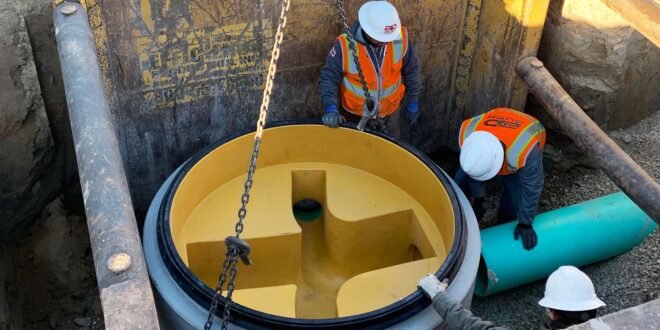
By contrast, lined manhole systems integrate corrosion protection directly into the structure. Rather than applying a coating to hardened concrete, an integrally cast in liner is mechanically embedded during the manhole pouring process. This creates a permanent bond that resists peeling, cracking, or back pressure—a common failure point for sprayed systems that rely on chemical adhesion.
As Alena Mikhaylova, PhD, Product Manager from NWPX Infrastructure, explains, “Most municipalities look only at the annual budget—how many manholes they can rehab this year—not the total cost over 50 years. When they do that math, the picture changes dramatically.”
Lifecycle economics of manhole systems
Upfront, a lined manhole typically costs 30–40% more than a comparable sprayed system. That initial difference — often viewed as a deterrent — quickly dissolves when lifecycle costs are examined.
Sprayed coatings must be reapplied every seven to 10 years, with inflation adding, on the conservative side, roughly 3% annually to material and labor costs. Over a 50-year timeline, municipalities would pay for anywhere from five to seven coating cycles, each more expensive than the last. According to modeling from NWPX Infrastructure, the total materials cost alone can reach six times that of a lined manhole over the same period.
And materials are only part of the equation. Each recoating requires dewatering, pump rentals, traffic control, and bypass—a process which can cost thousands of dollars per day. When those indirect costs are factored in, lined manholes deliver up to 65% savings over their lifetime, often breaking even by the time the first recoat cycle would roll around.
As Dr. Mikhaylova notes, “Factory-lined manholes require virtually no maintenance. Once installed, the structure is sealed against infiltration and corrosion. Cities save on labor, inspections, maintenance, and emergency repairs—all of which compound over time.”
Materials that extend service life
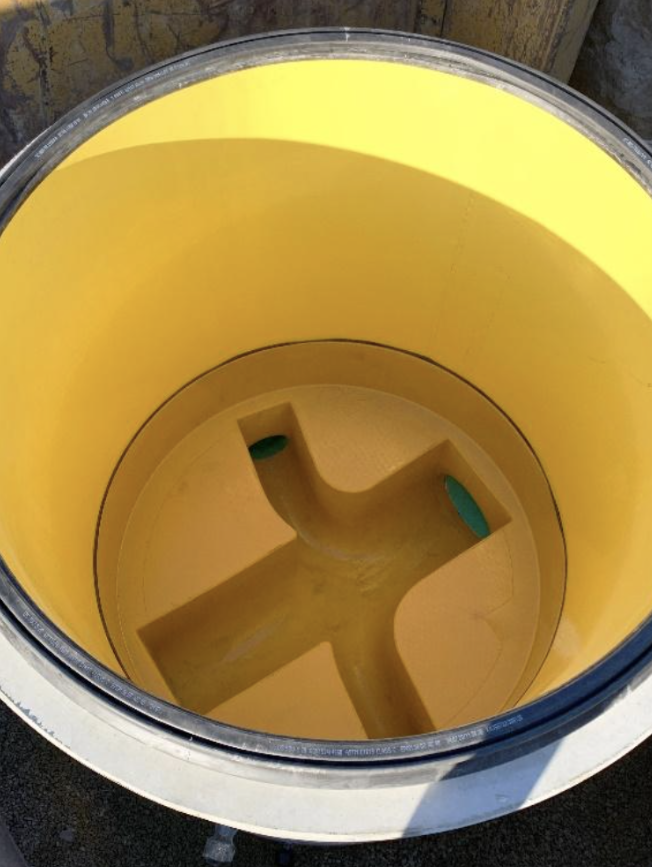
The difference between these systems begins at the material level. Lined manhole systems are manufactured using two specialized liners that work together to resist corrosion and chemical attack. The base is lined with fiber-reinforced plastic (FRP) — a composite of chopped glass fibre and resin that has been rigorously tested for tensile strength, acid resistance, and non-porosity. Above that, the riser walls incorporate a high-density polyethylene (HDPE) liner that is exceptionally smooth, dense, and resistant to hydrogen sulfide (H₂S) corrosion, the leading cause of concrete degradation in wastewater environments.
Each liner contains anchors that mechanically embed into the concrete, creating a physical bond rather than a chemical one. This eliminates the risk of delamination or bubbling caused by water intrusion between the liner and the wall — a common failure mode for sprayed coatings. The result is a structure with a 100-year design life and a 50-year warranty against corrosion, virtually eliminating reapplication cycles altogether. Smooth liner surfaces also minimise debris accumulation, reducing maintenance frequency and inspection labour.
These systems are engineered to meet ASTM C478 and AASHTO M199 standards, ensuring reliable structural performance under traffic and soil loads. With steel reinforcement and wall thicknesses of five inches and up, lined manholes maintain the strength of traditional precast concrete while vastly improving longevity.
Polymer concrete and beyond
Another corrosion-resistant option — polymer concrete — offers durability similar to lined systems, but at a much higher price. Polymer manholes replace Portland cement with synthetic resin, creating a dense, non-porous structure. However, this material is 20–25% more expensive to produce due to the specialised processes and equipment required for resin polymerization, which adds significant cost and complexity to manufacturing compared to lined concrete manholes.
In addition to higher material costs, polymer concrete introduces logistical challenges. The structures are more brittle under tension, and less forgiving if damaged during transport or unloading. Contractors report that cracks in polymer manholes are difficult or impossible to repair in the field, often requiring replacement or return to the manufacturer. Availability is also limited, with only a handful of U.S. suppliers producing polymer concrete manholes — causing longer lead times and potential project delays.
By comparison, lined precast systems combine the corrosion resistance of polymer concrete with the economics and availability of traditional precast manufacturing. NWPX’s Perfect Lined Manhole integrates this approach, pairing standard reinforced concrete with corrosion-proof liners and watertight rubber gaskets that eliminate infiltration and exfiltration.
The shift toward lined systems mirrors a broader movement in infrastructure management: the transition from reactive maintenance to proactive asset management. As Dr. Mikhaylova puts it, “Asset management programs are showing that permanent solutions not only perform better but are also more responsible investments for taxpayers.”
Municipalities that track the full lifecycle cost of their systems, rather than annual maintenance line items, are recognizing that long-term durability is the only sustainable path forward.
This change is being accelerated by EPA consent decrees, which mandate corrosion-resistant materials in new or rehabilitated sewer systems. Cities like those in Utah are already moving in this direction, adopting lined manholes as a permanent protection standard for high-flow or lift station zones. At the same time, rising labor costs and skilled workforce shortages are widening the gap between lined and sprayed systems. Each coating application requires specialised crews, confined space work, and precise curing windows—all of which drive up cost and risk. Lined systems are delivered ready-to-install, require no specialized tools or training, and minimize exposure hazards.
For municipalities seeking to modernise their wastewater systems, the message is clear: short-term savings often lead to long-term costs. Each recoat, bypass, and repair adds up, financially and operationally. Lined manhole systems, while more expensive upfront, eliminate the need for repeated interventions, yielding lasting value through reduced maintenance, faster installation, and extended service life. In a field defined by infrastructure strain and public accountability, the most economical choice isn’t always the cheapest, it’s the one that endures.